
BROWSER COMPATIBILITY
WEB DEVELOPMENT
Progressive Enhancement vs Graceful Degradation Explained
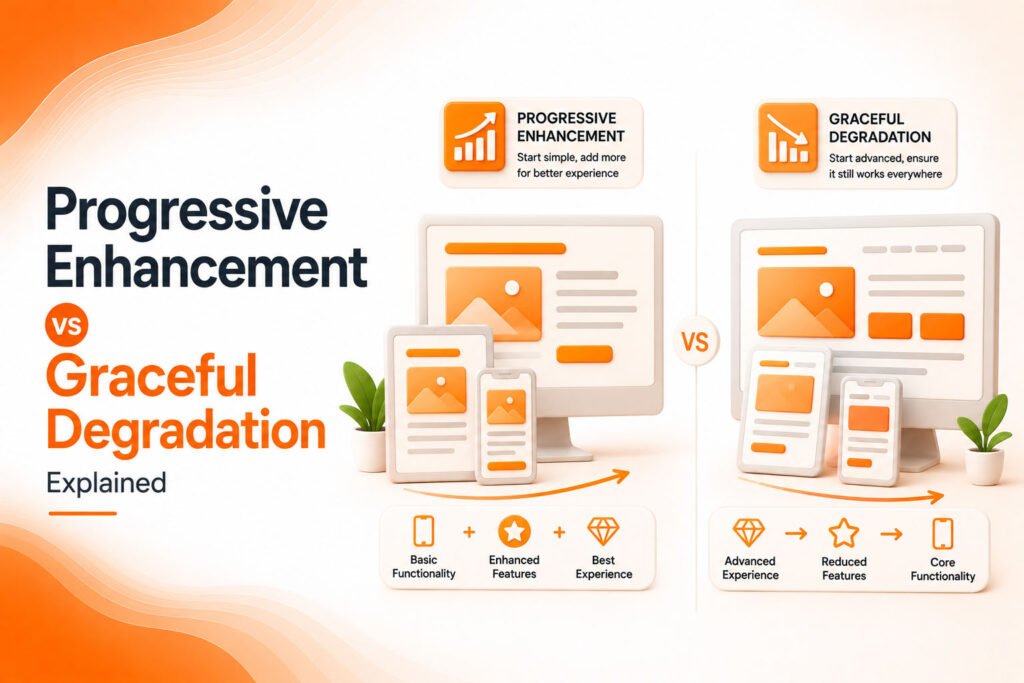
Two opposite starting points solving the same problem making sure your website works reliably across every browser and device.
Why Every Website Needs a Compatibility Strategy
Progressive enhancement vs graceful degradation represents two genuinely different philosophies for handling the same underlying challenge: not every visitor uses the same browser, device, or connection speed, yet a website needs to function reasonably well across this genuinely wide range of circumstances rather than only working perfectly for whoever has the newest, most capable setup.
Browser compatibility strategy matters because assuming every visitor has the latest browser and fastest connection risks excluding a genuine portion of your actual audience. Both progressive enhancement and graceful degradation address this reality, just approaching the solution from opposite directions.
The Building Blocks of Each Approach
Web development approach decisions between these two philosophies shape how a site handles varying browser capabilities from the ground up.
- Progressive enhancement starts with a basic, functional core
- Graceful degradation starts with the full, ideal experience
- Progressive enhancement adds features for capable browsers
- Graceful degradation removes features for limited browsers
- Both aim for the same outcome through opposite starting points
Understanding these different starting philosophies helps determine which approach genuinely fits your specific project and audience needs.
Ready for a website that works reliably for every visitor?
How Progressive Enhancement Actually Works
Progressive enhancement builds a website starting from a basic, fully functional core typically clean, semantic HTML ensuring core content and functionality work even without CSS styling or JavaScript enabled at all. From this reliable foundation, additional layers of enhancement get added for browsers and devices genuinely capable of supporting them, improving the experience without breaking the underlying functionality for more limited setups.
This approach means a visitor using an older browser, or one with JavaScript disabled for whatever reason, still experiences a genuinely functional website, just without certain visual enhancements or interactive features that more capable browsers receive. The core experience remains intact regardless of the visitor’s specific technical circumstances.
💡
Tip
Test your site's core functionality with JavaScript disabled entirely. If critical features completely break rather than gracefully falling back to basic functionality, that reveals a genuine progressive enhancement gap worth addressing.
How Graceful Degradation Takes the Opposite Path
Graceful degradation starts from the opposite direction building the full, ideal experience first, assuming modern browser capabilities, then adding fallback handling for older or more limited browsers that can’t support certain advanced features. Rather than building up from a basic core, this approach builds down from a complete, feature-rich starting point.
This philosophy assumes the majority of visitors use reasonably modern, capable browsers, with fallback handling existing primarily as a safety net for the genuine minority using older or more limited setups, rather than treating basic compatibility as the fundamental starting requirement guiding the entire initial build process.
2-5%
Typical share of visitors using significantly older or limited browsers
100%
Core functionality guaranteed with proper progressive enhancement
15-20%
Development time difference between approaches, depending on project complexity
Which Approach Genuinely Fits Your Project
Responsive design principles increasingly favor progressive enhancement as the generally preferred modern approach, since it inherently prioritizes accessibility and reliable core functionality from the very start, rather than treating compatibility as an afterthought layered onto an already-complete, feature-rich design built without those constraints in mind initially.
That said, graceful degradation remains genuinely appropriate for certain projects, particularly those where the target audience overwhelmingly uses modern, capable browsers and where development resources are better spent on the core, ideal experience rather than extensively supporting a genuinely small minority of older browser users who may represent an insignificant fraction of actual site traffic.
Practical Implementation Considerations
In practice, many modern development teams blend elements of both approaches rather than adhering strictly to one philosophy exclusively. Semantic HTML and core content accessibility follow progressive enhancement principles as a baseline, while more advanced interactive features might use feature detection to provide enhanced experiences for capable browsers, with reasonable, functional fallbacks for those that genuinely can’t support specific advanced functionality.
This pragmatic blending acknowledges that pure ideological adherence to either single philosophy matters less than the genuine outcome a website that functions reliably across the actual range of browsers and devices your specific audience genuinely uses, based on real traffic data rather than theoretical assumptions about compatibility needs.
It doesn't matter which direction you build from what matters is that every visitor, regardless of their browser or device, genuinely gets a website that works.
Common Compatibility Strategy Mistakes to Avoid
Even experienced development teams fall into familiar traps: assuming every visitor uses the latest browser without checking actual traffic data, building features that completely break rather than gracefully falling back for limited browsers, or over-investing development time supporting an insignificantly small share of legacy browser traffic.
The fix isn’t rigidly choosing one philosophy exclusively it’s understanding your actual audience’s browser and device usage, then applying whichever approach, or thoughtful combination, genuinely serves that real audience best.
How IWS Solutions Can Help
Our team builds websites with genuine cross-browser reliability in mind, applying progressive enhancement and graceful degradation principles appropriately based on your actual audience and project needs.