
CDN
WEB PERFORMANCE
What Is a CDN and Does Your Website Need One?
A network of servers spread across the globe, quietly making your website faster for visitors no matter where they are.
Why Location Affects Website Speed More Than You'd Think
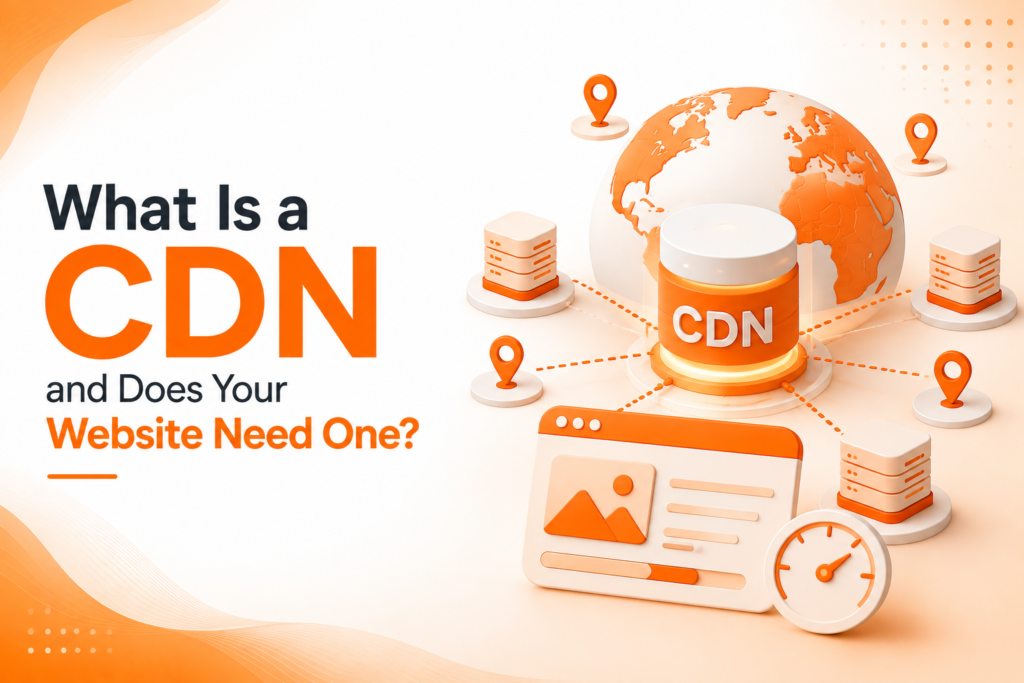
What is a CDN? A Content Delivery Network is a system of geographically distributed servers that store cached copies of your website’s content, serving it to visitors from whichever server is physically closest to them, rather than every request traveling back to your site’s single, original hosting location regardless of distance.
Content delivery network technology matters because physical distance genuinely affects load speed. A visitor in Australia requesting content from a server hosted in the United States experiences noticeably slower load times than a visitor closer to that same server, simply due to the time data takes to travel across that greater physical distance.
The Building Blocks of CDN Functionality
CDN benefits stem from a combination of distributed infrastructure and smart caching working together to reduce load times for visitors everywhere.
- Cached content stored across multiple global server locations
- Automatic routing to the nearest available server
- Reduced load on your primary hosting server
- Built-in protection against traffic spikes and certain attacks
- Faster delivery of images, scripts, and static assets
When these elements work together, visitors experience faster load times regardless of their physical distance from your primary server.
Ready for a website that loads fast for visitors everywhere?
How a CDN Actually Works
How CDN works comes down to caching — storing copies of your website’s static content (images, CSS files, JavaScript, and sometimes full pages) across numerous server locations worldwide, often called “edge” servers. When a visitor requests your site, the CDN automatically routes that request to whichever edge server sits geographically closest, dramatically reducing the physical distance data needs to travel.
This process happens automatically and invisibly to visitors they simply experience a faster-loading website without ever needing to know a CDN is involved behind the scenes, handling the technical routing and caching that makes that improved speed genuinely possible.
💡
Tip
Test your site's load speed from a location far from your primary server using a free tool like GTmetrix's multiple test locations. A significant speed difference between nearby and distant locations signals genuine CDN benefit potential.
Does Your Website Genuinely Need a CDN?
Does my website need a CDN depends significantly on your actual audience distribution and traffic volume. Sites with a genuinely global or geographically dispersed audience benefit most clearly, since visitors far from your primary hosting location experience the most noticeable speed improvement from CDN implementation.
Even sites with a primarily local or regional audience can benefit from CDN’s additional advantages beyond pure geographic speed reduced load on your primary server during traffic spikes, built-in protection against certain types of malicious traffic, and generally improved reliability through the distributed infrastructure a CDN provides.
50%
Average load time reduction for sites implementing a CDN
200+
Typical number of edge server locations major CDN providers maintain
Free
Cost of basic CDN service through several popular providers
CDN vs Hosting: Understanding the Difference
CDN vs hosting represents a common point of confusion worth clarifying. Your web hosting is where your website’s actual files, database, and core functionality genuinely live the original source. A CDN doesn’t replace hosting; it works alongside it, caching and distributing copies of your content to reduce how often visitors need to reach that original hosting server directly.
This complementary relationship means most websites benefit from having both good hosting and CDN implementation together, rather than viewing them as competing or alternative solutions. Even excellent hosting has physical location limitations that a properly configured CDN specifically addresses through its distributed server network.
Additional Benefits Beyond Speed
Beyond pure speed improvement, CDN implementation offers genuine additional value. Traffic spike protection matters significantly for sites that occasionally experience sudden surges a viral social media mention or major promotional campaign — since the distributed CDN infrastructure absorbs much of that increased load rather than overwhelming your single, primary hosting server directly.
Many CDN providers also include basic security features, helping filter out certain malicious traffic patterns before they reach your actual server. This added protection layer provides genuine value beyond speed alone, contributing to overall site reliability and security posture without requiring separate, additional security infrastructure investment.
A CDN doesn't make your website faster for you it makes it faster for every single visitor, no matter where in the world they happen to be.
Common CDN Mistakes to Avoid
Even technically capable teams fall into familiar traps: assuming a CDN is only necessary for large, high-traffic sites, configuring caching rules incorrectly and inadvertently serving outdated content, or neglecting to properly test performance improvement after implementation to confirm the CDN is genuinely functioning as intended.
The fix isn’t skipping CDN implementation because your site feels “too small” to need one it’s understanding that even modest sites often see genuine performance benefit, particularly with any geographically dispersed audience.
How IWS Solutions Can Help
Our team implements and configures CDN solutions for client websites, ensuring fast, reliable performance for visitors regardless of their geographic location relative to your primary hosting server.