
WEB HOSTING
WEB DEVELOPMENT
Web Hosting Types Explained: Shared vs VPS vs Dedicated
Three fundamentally different levels of server resources here’s how to know which one your website actually needs.
Why Hosting Choice Directly Affects Site Performance
Web hosting types determine far more than most business owners realize when signing up for the cheapest available plan. The underlying server resources — processing power, memory, and how many other websites share that same server directly affect site speed, reliability, and how well your site handles traffic growth over time.
Shared vs VPS vs dedicated represents a genuine progression in resources, cost, and control. Choosing the right tier for your current needs, while understanding when you’ll likely need to upgrade, prevents both overspending on unnecessary resources and the performance problems that come from outgrowing an inadequate hosting plan.
The Building Blocks of Each Hosting Type
Choosing web hosting requires understanding how each type fundamentally differs in resource allocation and shared infrastructure.
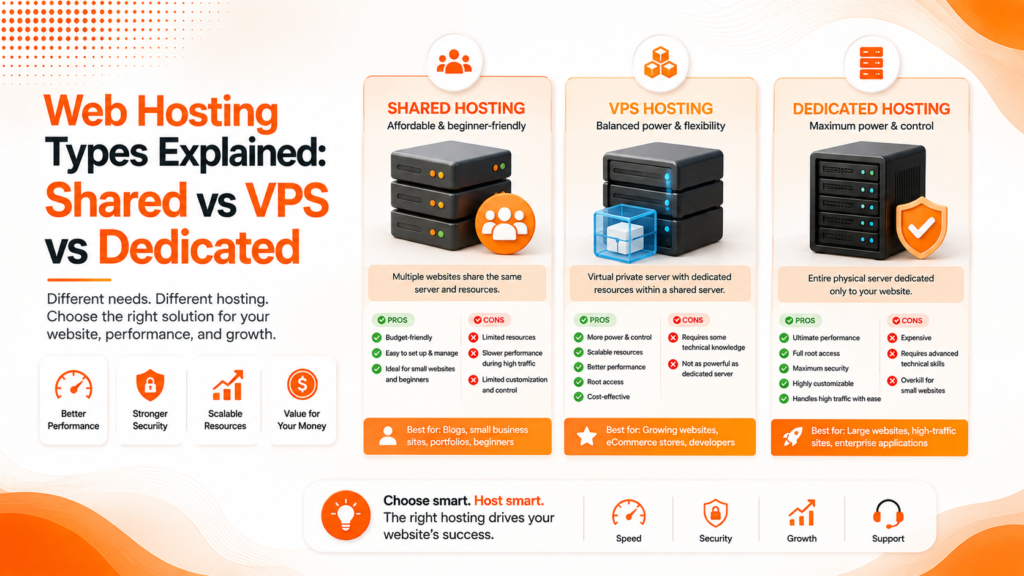
- Shared hosting: multiple sites sharing one server’s resources
- VPS hosting: a virtually partitioned, dedicated resource allocation
- Dedicated hosting: an entire physical server for one site
- Cost increases significantly with each tier of dedicated resources
- Technical management responsibility also increases at higher tiers
Understanding these fundamental differences helps match hosting choice to genuine current and near-future needs.
Ready for hosting that actually matches your website's needs?
Shared Hosting: The Accessible Starting Point
Shared hosting places multiple websites on a single physical server, splitting available resources processing power, memory, storage among all sites hosted there simultaneously. This shared arrangement makes it by far the most affordable option, often costing just a few dollars monthly, making it a genuinely practical starting point for new websites with modest traffic expectations.
The tradeoff is reduced control and potential performance impact from other sites on the same server. If another website sharing your server experiences a traffic spike or technical issue, it can occasionally affect your own site’s performance too, since you’re all drawing from the same limited pool of shared resources.
💡
Tip
If your site regularly slows during traffic spikes despite reasonable visitor numbers, that's often a sign you've outgrown shared hosting's resource limitations, not necessarily a website code problem.
VPS Hosting: A Meaningful Middle Ground
VPS hosting Virtual Private Server still involves sharing a physical server with other sites, but uses virtualization technology to allocate each site its own dedicated slice of resources, isolated from other sites on that same physical machine. This means your site’s performance isn’t affected by another site’s traffic spike the way shared hosting’s fully pooled resources can be.
Best hosting for small business considerations often point toward VPS once a site has grown beyond what shared hosting comfortably handles established stores, growing content sites, or businesses needing more consistent performance without yet requiring an entire dedicated server’s full resources and cost.
$3–$10/mo
Typical shared hosting cost range
$20–$80/mo
Typical VPS hosting cost range
$80–$300+/mo
Typical dedicated hosting cost range
Dedicated Hosting: Maximum Resources and Control
Dedicated hosting provides an entire physical server exclusively for one website or business, eliminating any resource sharing with other sites entirely. This delivers the highest possible performance ceiling, complete server configuration control, and consistent resource availability regardless of what other websites elsewhere might be experiencing.
This level typically suits high-traffic eCommerce stores, large content platforms, or businesses with specific security or compliance requirements demanding complete server isolation. The significant cost increase and additional technical management responsibility mean dedicated hosting rarely makes sense until a business has genuinely outgrown VPS-level resources.
Matching Hosting Choice to Actual Traffic and Growth
Choosing web hosting shouldn’t be based purely on current traffic alone realistic growth projections matter too, since migrating between hosting types later, while entirely possible, does involve some technical effort and potential brief downtime during the transition process.
Most businesses reasonably start with shared or entry-level VPS hosting, upgrading as traffic and performance needs genuinely justify the increased cost, rather than either overpaying for dedicated resources unnecessarily early or straining under shared hosting’s limitations well past the point of outgrowing it.
The right hosting plan isn't the cheapest one or the most powerful one it's the one that actually matches how many resources your website genuinely needs right now.
Common Web Hosting Mistakes to Avoid
Even careful businesses fall into familiar traps: staying on shared hosting well past the point of genuine performance strain, jumping to expensive dedicated hosting before it’s actually necessary, or choosing hosting purely on price without considering uptime reliability and support quality.
The fix isn’t defaulting to the cheapest or most expensive option it’s honestly matching hosting resources to your site’s actual traffic, complexity, and realistic near-term growth.
How IWS Solutions Can Help
Our team helps businesses choose and configure the right hosting solution for their specific needs, ensuring your website has the resources it needs to perform reliably as traffic grows.