
VISUAL IDENTITY
BRANDING
Illustration vs Photography: Which Fits Your Brand Better?
Two distinct visual approaches, each communicating something different here’s how to decide which one genuinely serves your brand.
Why This Choice Shapes Your Entire Visual Identity
Illustration vs photography isn’t purely an aesthetic preference each approach communicates fundamentally different qualities and works better for different brand positioning. Brand imagery choices influence everything from perceived approachability to how premium or accessible a business feels within the first few seconds of encountering its visuals.
Choosing visual style deliberately, rather than defaulting to whatever’s easiest to produce, ensures the imagery genuinely reinforces brand personality rather than simply filling visual space without strategic purpose behind the decision.
The Building Blocks of Choosing the Right Visual Approach
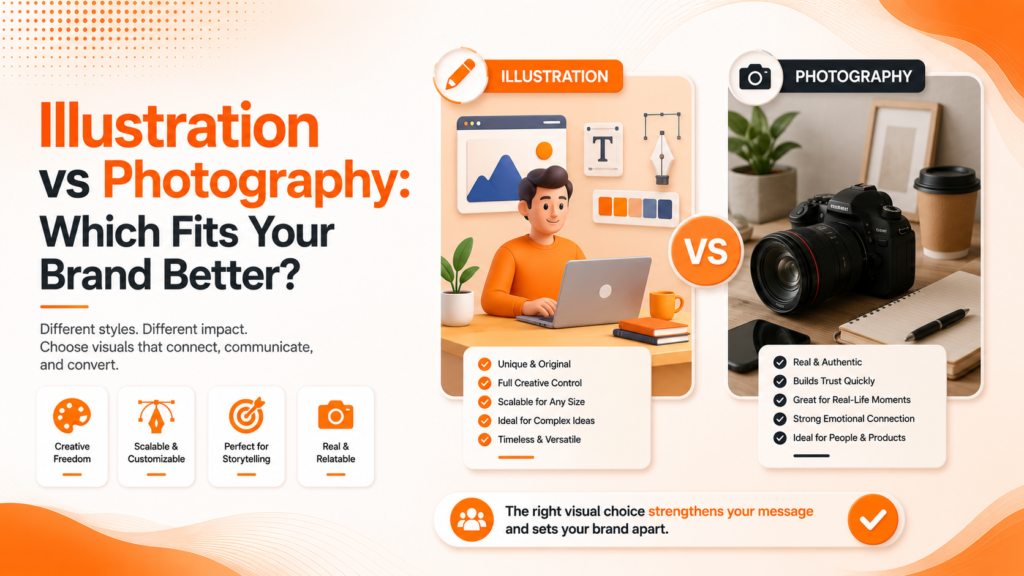
Custom illustration design and photography each bring distinct strengths that align better with certain brand goals and industries than others.
- Illustration offers complete creative control and consistency
- Photography provides authenticity and real-world credibility
- Illustration scales flexibly across unusual or abstract concepts
- Photography builds trust through genuine, relatable imagery
- Both can work together strategically within one brand system
Understanding these distinct strengths helps determine which approach or combination genuinely serves your specific brand goals.
Ready for visual identity that genuinely fits your brand?
What Illustration Communicates
Brand illustration offers something photography fundamentally can’t: complete creative control over every visual detail, unconstrained by physical reality. This makes illustration particularly effective for abstract concepts, complex processes, or brands wanting a distinctive, ownable visual style that can’t simply be replicated by competitors using stock photography.
Illustration also provides genuine consistency advantages every illustrated piece can maintain identical style, proportions, and color treatment regardless of subject matter, creating a cohesive visual system that’s often harder to achieve consistently across varied photography, particularly when working with different photographers or shooting locations over time.
💡
Tip
If your product or service is difficult to photograph compellingly software, complex services, or abstract concepts illustration often communicates your value proposition more clearly than trying to force an awkward photographic representation.
What Photography Communicates
Photography for branding delivers something illustration inherently cannot: genuine authenticity and real-world credibility. Real product photos, real customer testimonials, and real team photography build trust specifically because audiences recognize them as unedited representations of actual reality, not a stylized creative interpretation.
This authenticity matters particularly for industries where trust and tangible proof genuinely matter healthcare, professional services, or any business where customers want concrete visual evidence of real people, real results, or real environments before making a purchase decision.
67%
Of consumers say authentic photography increases purchase confidence
45%
Higher brand recall for distinctive illustrated visual systems
52%
Of brands now use a hybrid illustration and photography approach
When Illustration Style Makes the Most Sense
An illustration style guide works particularly well for tech companies, educational platforms, and brands targeting younger, more casual audiences, where a friendly, distinctive illustrated style helps humanize otherwise abstract or technical concepts. Startups and digital products especially benefit from illustration’s ability to explain complex functionality visually, without requiring an actual physical product to photograph.
Illustration also proves valuable for brands still establishing their market position, since a genuinely distinctive illustration style can differentiate a newer brand more immediately and memorably than photography, which often risks looking similar to countless competitors using comparable stock or lifestyle imagery.
When Photography Style Makes the Most Sense
Photography for branding remains the stronger choice for businesses selling physical products, food and hospitality brands, or any company where showing real people and real environments genuinely builds necessary trust and desire. Fashion, real estate, and food industries in particular rely heavily on photography’s ability to showcase actual texture, quality, and appeal that illustration simply can’t replicate convincingly.
Service-based businesses focused on personal connection coaches, consultants, healthcare providers also typically benefit more from genuine photography, since potential clients want to see and connect with the actual real people they’d be working with directly.
Combining Both for a Complete Visual System
Many successful brands don’t choose exclusively between illustration and photography they strategically combine both, using photography for authentic, trust-building content like testimonials and product shots, while using illustration for explaining processes, decorating marketing materials, or creating distinctive visual elements that photography alone couldn’t achieve as memorably.
This hybrid approach requires careful visual system planning to ensure both elements feel cohesive rather than randomly combined, typically achieved through consistent color treatment and thoughtful placement that makes the combination feel intentional rather than mismatched.
Illustration tells people who you want to be. Photography shows them who you actually are. The strongest brands know exactly when to use each.
Common Illustration and Photography Mistakes to Avoid
Even design-conscious businesses fall into familiar traps: choosing generic stock photography that looks identical to competitors, using illustration for content that genuinely needs authentic proof, or combining both styles inconsistently without a cohesive visual system tying them together.
The fix isn’t picking whichever is trendier it’s strategic alignment with your specific brand and industry. Visual choices that genuinely match your brand’s needs will outperform stylistically impressive but strategically mismatched imagery almost every time.
How IWS Solutions Can Help
Our team helps brands choose and develop the right visual approach, whether custom illustration, strategic photography, or a thoughtful hybrid system, ensuring your imagery genuinely reinforces your brand identity.