
LMS
EDUCATIONAL WEBSITES
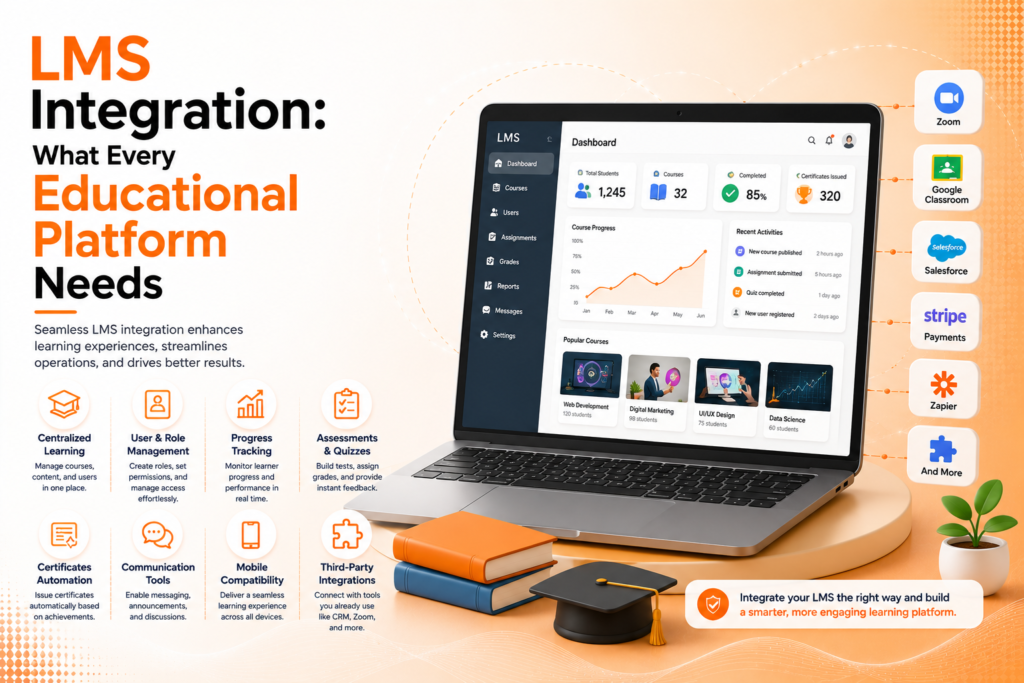
LMS Integration: What Every Educational Platform Needs
A practical guide to choosing and integrating a learning management system that actually supports how your institution teaches.
Why LMS Integration Deserves Careful Planning
Lms integration is often treated as a simple plug-and-play decision, when in reality it shapes how effectively an entire institution delivers education online. A poorly integrated system creates friction for both instructors managing coursework and students trying to access materials, assignments, and grades.
A cloud based learning management system offers real advantages — accessibility from anywhere, automatic updates, and reduced infrastructure management but choosing the right one requires understanding your institution’s specific teaching model, not just picking whichever platform has the most features listed on its homepage.
The Building Blocks of Successful LMS Integration
An lms integration checklist isn’t one setup step it’s a combination of technical and instructional considerations that together determine whether the system genuinely supports teaching and learning.
- Seamless single sign-on with existing school systems
- A learning content management system that organizes materials clearly
- Mobile accessibility for students learning on the go
- Reliable grading and assessment tools
- Scalable infrastructure that grows with enrollment
When these elements are properly integrated, the LMS becomes a genuine teaching tool rather than an administrative burden layered on top of existing systems.
Ready for an LMS that actually fits how your institution teaches?
Choosing the Best Learning Management System
Finding the best learning management system starts with understanding your institution’s actual teaching model, not just comparing feature lists. A K-12 school managing simple assignment tracking has very different needs than an institution running complex, multi-format coursework with video lectures, discussion boards, and detailed analytics.
Top learning management systems for higher education specifically tend to prioritize deeper integration capabilities — connecting with student information systems, library resources, and video conferencing tools since university-level teaching typically requires more sophisticated coordination between multiple platforms than K-12 environments.
💡
Tip
Before choosing an LMS, map out your instructors' actual weekly workflow. A platform that looks impressive in a demo but adds extra steps to routine tasks will face resistance from staff.
Custom LMS Development vs. Off-the-Shelf Platforms
For institutions with highly specific requirements, custom lms development offers flexibility that off-the-shelf learning online platforms simply can’t match tailored workflows, unique branding, and integrations built specifically around existing systems rather than working around a platform’s built-in limitations.
That said, custom lms software development comes with significantly higher upfront cost and longer implementation timelines. Most institutions are well-served by established platforms with strong integration capabilities, reserving custom development for cases where genuinely unique requirements can’t be met any other way.
73%
Of educational institutions now use a cloud-based LMS
42%
Reduction in administrative workload with proper LMS integration
89%
Of students prefer institutions offering mobile-accessible coursework
Building an Effective Learning Content Management System
A learning content management system needs to do more than store files it should organize materials logically by course, module, and topic, making it easy for both instructors to upload and update content, and students to find exactly what they need without confusion.
Elearning platforms that get this right typically include version control for updated materials, clear folder structures, and search functionality that helps students quickly locate specific lessons or resources among potentially hundreds of files across a full semester.
Planning Your LMS Integration Checklist
Before implementation, working through a clear lms integration checklist prevents the most common rollout problems: unclear data migration plans, insufficient staff training, or integration gaps with existing school systems that only surface after go-live, when they’re far more disruptive to fix.
For institutions considering a custom elearning platform, this planning stage becomes even more critical, since custom builds require clearly defined requirements upfront vague specifications during development almost always lead to costly revisions later in the project.
The right LMS doesn't just store course content it disappears into the background, letting teaching and learning happen without the platform getting in the way.
Common LMS Integration Mistakes to Avoid
Even well-prepared institutions fall into familiar traps: choosing a platform based on price alone without testing actual instructor workflows, skipping staff training before rollout, or underestimating the data migration effort from a previous system.
The fix isn’t rushing implementation it’s thorough planning. A carefully integrated LMS, rolled out with proper training, will outperform a feature-rich platform implemented hastily almost every time.
How IWS Solutions Can Help
Our team supports both platform-based lms integration and custom lms development, helping educational institutions choose and implement a system that genuinely fits how they teach, not just what looks impressive in a sales demo.