
EDUCATIONAL WEBSITES
WEB DEVELOPMENT
What Features Should a School Website Have?
A practical guide to the essential features every school website needs to serve students, parents, and staff effectively.
Why School Website Design Requires a Different Approach
School website design isn’t like building a typical business website it serves multiple, very different audiences simultaneously. Prospective parents researching enrollment, current parents checking announcements, students accessing coursework, and staff managing administrative content all need to find what they’re looking for quickly, without wading through irrelevant sections built for someone else.
Website design for schools that ignores these different audience needs often ends up serving none of them well a single, generic homepage trying to speak to everyone at once usually confuses the specific visitor who arrived with one clear task in mind.
The Building Blocks of an Effective School Website
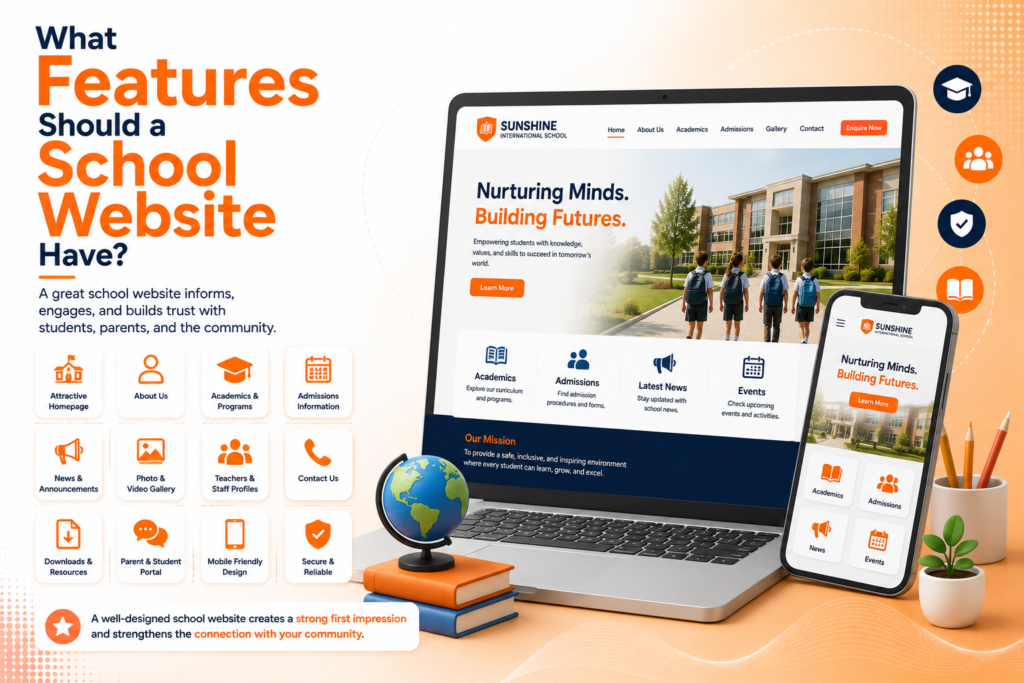
An education website design isn’t one homepage it’s a combination of features working together to serve the school community’s genuinely different needs.
- Clear admissions and enrollment information
- A secure school portal for grades, assignments, and announcements
- Easy-to-find contact and staff directory information
- Mobile-responsive design for parents checking on the go
- Accessible design that works for all students and families
When these features are built with intention, the website becomes a genuine daily resource, not just a digital brochure.
Ready for a school website that actually serves your community?
Essential Feature #1: A Secure School Portal
A school portal is often the most-used feature on the entire site, giving students and parents secure access to grades, assignments, attendance records, and direct communication with teachers. Without this, schools typically rely on scattered emails and phone calls that are far less efficient for everyone involved.
The portal needs to feel simple even to parents who aren’t especially tech-savvy, since frustration here directly translates into support calls to the school office. Clear labeling, straightforward login processes, and mobile compatibility all matter more here than visual flourishes.
💡
Tip
Test your school portal login process on a parent's phone, not just a staff desktop. Most parents check school information during short windows between other daily tasks.
Essential Feature #2: Clear Admissions Information
For a children’s educational website, especially private or specialized schools competing for enrollment, admissions information needs to be immediately easy to find. This includes application deadlines, tuition and fee details, required documents, and a clear next step whether that’s scheduling a tour or starting an application online.
Prospective parents researching schools are often comparing multiple options simultaneously. A website that makes this information difficult to find, or buries it several clicks deep, risks losing that family to a competing school with a clearer, more accessible admissions page.
73%
Of parents research schools online before contacting them directly
94%
Of users judge credibility based on website design
60%
Of school website traffic comes from mobile devices
Essential Feature #3: Accessible, Well-Organized Content
Education website design needs to accommodate a wide range of visitors, including parents and students with different accessibility needs. This means proper color contrast, readable font sizes, alt text for images, and navigation that works well with screen readers not as an afterthought, but built in from the start.
Beyond accessibility, content organization matters significantly. A clear structure separating information by audience a distinct section for prospective families, current students, and staff prevents the confusion that comes from mixing all content into one undifferentiated homepage.
Essential Feature #4: Easy-to-Manage Updates
School staff, not developers, typically need to update event calendars, announcements, and news regularly throughout the school year. Website design for schools should include a content management system simple enough for non-technical staff to use confidently, without requiring outside help for routine updates.
This is particularly important for time-sensitive content snow day announcements, event changes, or emergency notices need to be updatable immediately by staff on hand, not delayed by needing to contact an external developer for every small change.
A school website isn't a brochure it's a daily tool that parents, students, and staff actually rely on to stay informed and connected.
Common School Website Mistakes to Avoid
Even well-intentioned schools fall into familiar traps: burying admissions information deep in the navigation, launching a portal that’s confusing for non-technical parents, or building a site that looks great on desktop but breaks on mobile.
The fix isn’t more content it’s better organization. A clearly structured site built around what each visitor actually needs will outperform a feature-packed but confusing one almost every time.
How IWS Solutions Can Help
Our team builds education website design solutions tailored to schools of every size, from secure portals to accessible, mobile-friendly public-facing pages that genuinely serve your entire school community.