
MARKETING ANALYTICS
ROI
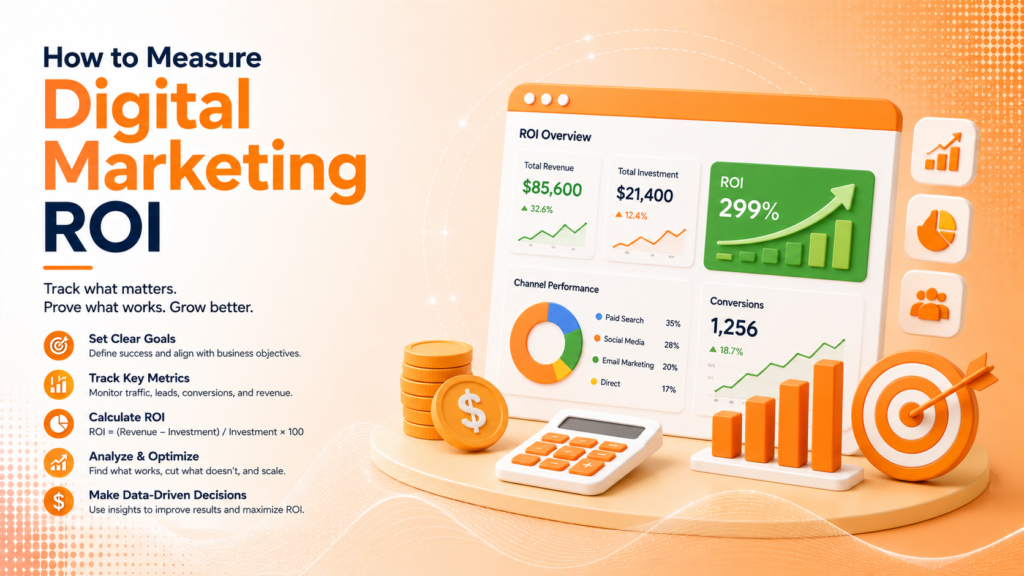
How to Measure Digital Marketing ROI
A practical guide to tracking what’s actually working so every marketing dollar can be justified with real data, not guesswork.
Why Measuring ROI Is Where Most Businesses Fall Short
Digital marketing roi should be one of the simplest numbers to calculate money in versus money out yet most businesses struggle to answer it confidently. The problem usually isn’t a lack of data; it’s too much scattered data across platforms that never gets connected into one clear picture.
What is roi in marketing, really? At its core, it’s revenue generated from marketing efforts divided by what was spent to generate it. Simple in theory, but genuinely useful only when attribution knowing which specific channel or campaign drove which result is set up correctly from the start.
The Building Blocks of Accurate ROI Measurement
Measuring roi accurately isn’t one formula it’s a combination of tracking systems and metrics that together reveal the true return on marketing investment.
- Clean conversion tracking across every channel
- Clear attribution showing which touchpoint drove each result
- Consistent cost tracking, including time and tools, not just ad spend
- Defined KPIs tied to actual business goals
- Regular reporting that connects data back to revenue
When these pieces are in place, ROI stops being an estimate and becomes a genuinely trustworthy number.
Ready to know exactly what your marketing is actually returning?
Understanding Marketing KPIs Before You Measure ROI
Before ROI makes sense, it helps to understand what are kpis in marketing and why they matter. Marketing kpis are the specific, measurable indicators cost per lead, conversion rate, customer acquisition cost that show whether a campaign is moving toward its actual goal, not just generating activity.
Choosing the right KPIs depends entirely on the campaign’s purpose. An awareness campaign should be measured by reach and engagement, not immediate sales, while a lead generation campaign needs cost-per-lead and conversion rate front and center. Measuring the wrong KPI for a campaign’s actual goal is one of the most common reasons businesses misjudge whether marketing is working.
💡
Tip
Before adding another marketing analytics tool, make sure conversion tracking is correctly installed and tested. Sophisticated dashboards built on broken tracking data are worse than no dashboard at all.
Setting Up Marketing Analytics That Actually Work
Proper marketing analytics starts with connecting every channel to a single source of truth typically Google Analytics paired with platform-specific tools like Meta Ads Manager or Google Ads. Without this connection, businesses end up comparing incompatible numbers across platforms and drawing incorrect conclusions about what’s actually performing.
Recent google analytics updates have made cross-channel tracking more accurate, but only when implemented correctly from the start. Businesses working with a marketing analytics agency often see clearer ROI reporting simply because proper setup goals, conversion events, UTM parameters — gets configured correctly the first time, rather than patched together after data has already been lost.
44%
Of marketers say proving ROI is their biggest reporting challenge
5x
Higher marketing efficiency with proper attribution tracking
63%
Of businesses use more than one platform for marketing analytics tools
Calculating Content Marketing ROI
Content marketing roi is notoriously harder to measure than paid ads, since content often influences a purchase decision long before a direct conversion happens. Someone might read a blog post today and convert three months later through an entirely different channel, making simple last-click attribution misleading for content specifically.
A more accurate approach tracks assisted conversions recognizing when content played a role earlier in the customer journey, even if it wasn’t the final touchpoint before purchase. This requires slightly more sophisticated attribution setup, but it prevents content marketing from being unfairly judged as “not working” simply because its impact shows up indirectly rather than immediately.
Building Dashboards That Tell the Real Story
Raw data across five different platforms isn’t useful on its own it needs to be consolidated into a single, clear view. This is where marketing analytics tools like Google Looker Studio or dedicated marketing dashboards become valuable, pulling data from multiple sources into one report that actually answers the question: is this working?
The goal isn’t more data it’s clarity. A simple dashboard showing cost, conversions, and ROI by channel is far more useful for decision-making than a complex report packed with vanity metrics that don’t connect back to actual business outcomes.
You can't improve what you can't measure and you can't measure accurately if every channel is telling a different, disconnected story.
Common ROI Measurement Mistakes to Avoid
Even data-conscious businesses fall into familiar traps: relying on last-click attribution alone, ignoring the time and labor cost of campaigns when calculating ROI, or tracking vanity metrics that don’t actually connect to revenue.
The fix isn’t more dashboards it’s more accurate attribution. A simple, correctly tracked system will reveal true ROI far better than a complex report built on incomplete or inconsistent data.
How IWS Solutions Can Help
Our team sets up proper marketing analytics and reporting systems, helping you finally answer what your marketing is actually returning with clear KPIs and dashboards tied directly to real business outcomes.