
SMALL BUSINESS
DIGITAL MARKETING
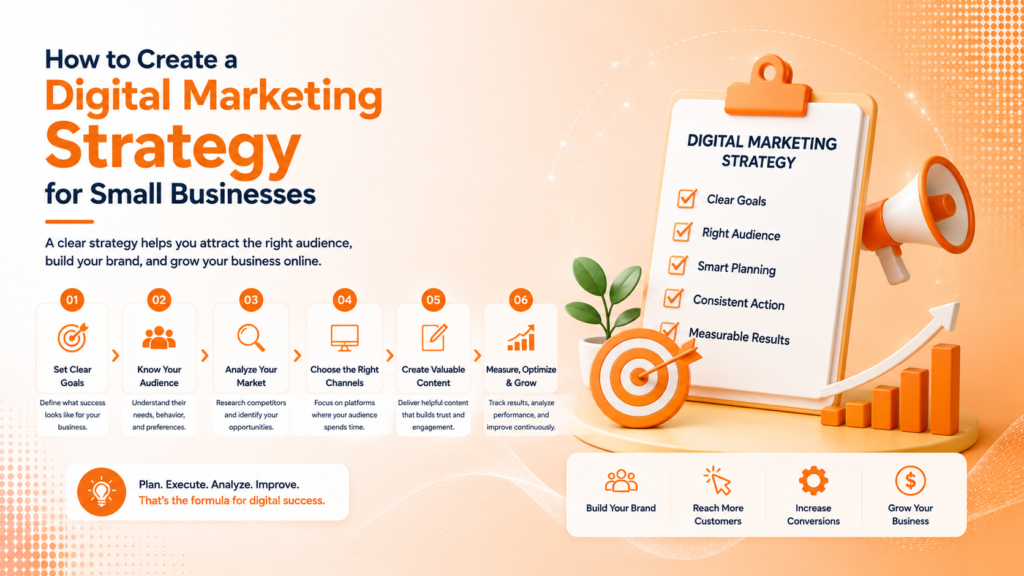
How to Create a Digital Marketing Strategy for Small Businesses
A practical, step-by-step digital marketing guide to help small businesses build a strategy that actually drives growth without a massive budget.
Why Small Businesses Need a Real Strategy, Not Random Tactics
Most small businesses don’t fail at digital marketing because they lack effort they fail because they’re posting on social media, running occasional ads, and sending emails without any of it connecting to a larger plan. Each tactic exists in isolation, so nothing compounds into meaningful growth.
A proper digital marketing strategy fixes this by starting with clear goals and working backward to the specific channels and tactics that actually support them. For digital marketing for small business specifically, this focus matters even more, since limited budgets can’t afford to be spread across channels that aren’t genuinely moving the business forward.
The Building Blocks of an Effective Strategy
A digital marketing plan isn’t one campaign it’s a combination of connected decisions that together determine whether marketing efforts actually reach and convert the right audience.
- Clear, specific business goals tied to real metrics
- A defined target audience, not “everyone”
- The right mix of channels based on where that audience actually is
- Consistent content and messaging across every channel
- A system for measuring what’s actually working
When these pieces are aligned, marketing stops feeling scattered and starts functioning as one coordinated system.
Ready for a digital marketing strategy built around your business?
Step 1: Define Clear, Measurable Goals
Every effective digital marketing strategy starts with a specific goal not “get more customers” but something measurable, like generating 20 qualified leads per month or increasing online sales by 15% over a quarter. Vague goals lead to vague strategies that are impossible to evaluate honestly later.
This step also determines which metrics actually matter. A business focused on lead generation should be tracking cost-per-lead and conversion rate, while an eCommerce business should prioritize return on ad spend and average order value. Chasing vanity metrics like follower count, without connecting them to real business goals, wastes both time and budget.
💡
Tip
Before choosing channels, write down exactly where your best customers already spend time online. This single question eliminates more wasted marketing spend than almost any other strategic decision.
Step 2: Choose the Right Channels for Your Audience
Digital marketing services for small business often go wrong at this exact step trying to maintain a presence on every platform instead of focusing deeply on the two or three channels where the target audience genuinely spends time. A local service business likely needs strong local SEO and Google Business Profile presence more than a national Instagram following.
Online marketing strategies for small business should prioritize depth over breadth. Being genuinely excellent on two channels consistently outperforms a thin, inconsistent presence spread across six, especially for businesses without a dedicated marketing team managing everything simultaneously.
63%
Of small businesses lack a documented marketing strategy
2.4x
Higher ROI reported by businesses with a documented digital marketing plan
42%
Of marketing budget wasted on poorly targeted channels
Step 3: Build a Consistent Content and Messaging System
Once channels are chosen, consistency becomes the priority. This means the same core messaging, tone, and value proposition across your website, social media, and email not identical content everywhere, but a recognizable thread that ties every touchpoint back to the same brand.
Digital marketing services built around content consistency typically start with a simple content calendar, mapping out what gets published where and how often. This removes the daily decision fatigue of “what should we post today” and replaces it with a system that keeps momentum going even during busy weeks.
Step 4: Track What's Actually Working
A strategy without measurement is just a set of assumptions. Setting up basic tracking website analytics, ad performance dashboards, and simple conversion tracking reveals which channels and campaigns are actually driving results, versus which ones just feel productive without real returns.
This step is where many small businesses either double down on what’s genuinely working or finally cut what isn’t, based on real data instead of gut feeling. Reviewing performance monthly, rather than setting a strategy once and forgetting it, keeps the plan responsive to what’s actually happening in the market.
A digital marketing strategy isn't about doing more it's about doing the right things consistently, instead of everything sporadically.
Common Strategy Mistakes to Avoid
Even motivated business owners fall into familiar traps: trying to be active on every platform at once, setting vague goals that can’t be measured, or abandoning a strategy after just a few weeks without giving it time to compound.
The fix isn’t more tactics it’s more focus. A simple, well-executed strategy across two or three channels will consistently outperform a scattered presence across everything, half-maintained.
How IWS Solutions Can Help
Our team provides complete digital marketing services for small business, building a strategy around your specific goals, audience, and budget not a generic template applied to every client the same way.