
WEBSITE DEVELOPMENT
NO-CODE
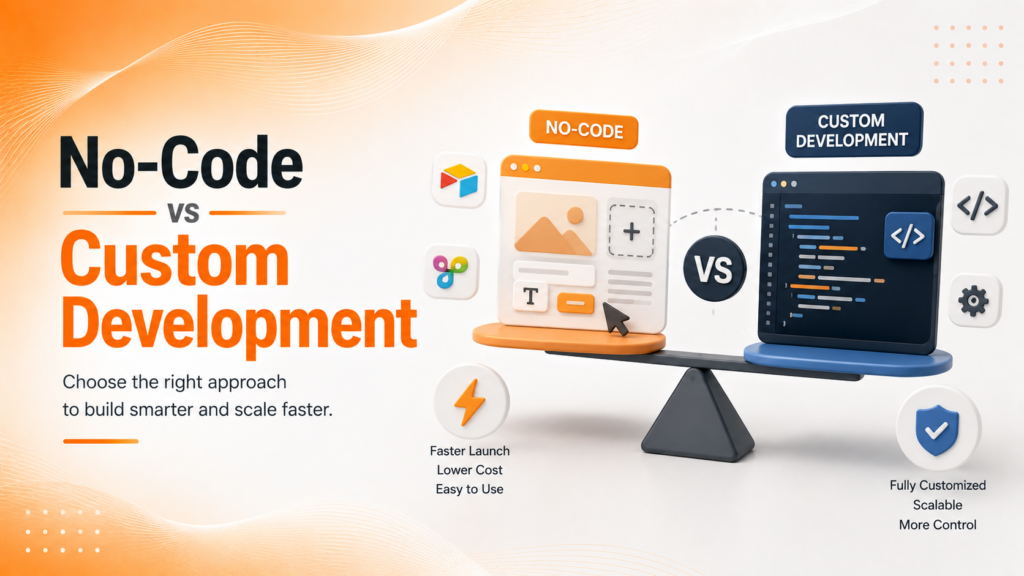
No-Code vs Custom Development
The right build approach isn’t about which is “better” it’s about matching the tool to what your project genuinely needs to succeed.
Why This Decision Deserves More Than a Quick Guess
No-code platforms have made launching a website or app faster and more accessible than ever, but that ease of entry often leads businesses to pick a build approach before genuinely understanding their project’s actual requirements. No-code vs custom development isn’t a question with one universally correct answer it depends on complexity, scalability needs, and how the project is expected to evolve over time.
Choosing the wrong approach early on tends to create real costs later, whether that’s a no-code platform hitting a hard ceiling on functionality, or custom development introducing unnecessary time and expense for a project that never needed that level of complexity.
The Factors That Actually Determine the Right Fit
Choosing between no-code and custom development means genuinely weighing several distinct factors, not just comparing upfront cost or speed to launch.
- Complexity of required features and integrations
- Long-term scalability and expected user growth
- Budget available now versus anticipated future investment
- Timeline pressure and how quickly the project needs to launch
- Ownership and flexibility needs over the underlying codebase
When these factors are weighed together, the right approach becomes considerably clearer than picking based on trend or initial cost alone.
Not sure which build approach genuinely fits your project?
When No-Code Genuinely Makes Sense
No-code platforms genuinely excel for projects with fairly standard requirements a landing page, a simple booking system, an internal tool with predictable workflows. They allow non-technical teams to launch quickly, iterate without waiting on developer availability, and keep upfront costs meaningfully lower.
The tradeoff emerges as requirements grow more specific. No-code platforms impose real limitations on custom functionality, unique integrations, and design flexibility, and businesses that outgrow these limits often face a difficult, costly migration to custom development later than they’d have preferred.
💡
Tip
Before committing to a no-code platform, map out your project's requirements for the next two years, not just launch day. If any planned feature sounds genuinely custom, that's worth weighing now.
When Custom Development Is Worth the Investment
Custom development becomes genuinely worthwhile when a project has unique functionality that off-the-shelf platforms can’t accommodate, expects significant scale, or requires full ownership and flexibility over the codebase for long-term strategic reasons. It typically involves higher upfront cost and longer timelines, but removes platform-imposed ceilings entirely.
This approach also matters when a business’s competitive advantage depends partly on functionality or user experience that a no-code template simply cannot replicate authentically.
58%
Of small business websites launch on no-code or low-code platforms
73%
Of businesses that outgrow no-code cite scalability as the reason
2x
Average development speed for no-code vs custom builds at launch
A Hybrid Approach Is Often Overlooked
Many businesses assume the decision is strictly binary, but a hybrid approach building core, standard functionality on no-code while custom-developing the genuinely unique or complex components often fits real-world projects better than committing fully to either extreme.
This middle path allows faster launch and lower initial cost, while still preserving flexibility for the specific features that meaningfully differentiate the business from competitors using similar templates.
Turning the Decision Into a Genuine Plan
The no-code vs custom decision only delivers real value when it’s grounded in an honest assessment of actual project requirements, rather than a default toward whichever approach feels more familiar or fashionable at the time. Growth plans, required integrations, and budget realities should directly inform the choice.
This also benefits from periodic revisiting rather than treating the initial build decision as permanent, since a project’s genuine needs and the platforms available continue evolving well beyond launch.
The question isn't whether no-code or custom development is better it's which one your project will still be genuinely comfortable in two years from now.
Common Mistakes to Avoid
Even experienced teams fall into familiar traps: choosing no-code purely for lower upfront cost while ignoring known future complexity, or defaulting to custom development for a genuinely simple project that never needed it.
The fix isn’t picking based on trend or budget alone it’s an honest evaluation of what the project actually requires, now and as it grows.
How IWS Solutions Can Help
Our team helps businesses evaluate their genuine project requirements and choose or combine no-code and custom development approaches that fit real goals, not just launch-day convenience.