
MARKETING PSYCHOLOGY
BRAND FREQUENCY
The Rule of Seven: How Many Times Do Customers Need to See You?
A decades-old marketing principle still shaping how businesses think about frequency, repetition, and building genuine buyer trust.
Why One Impression Almost Never Converts
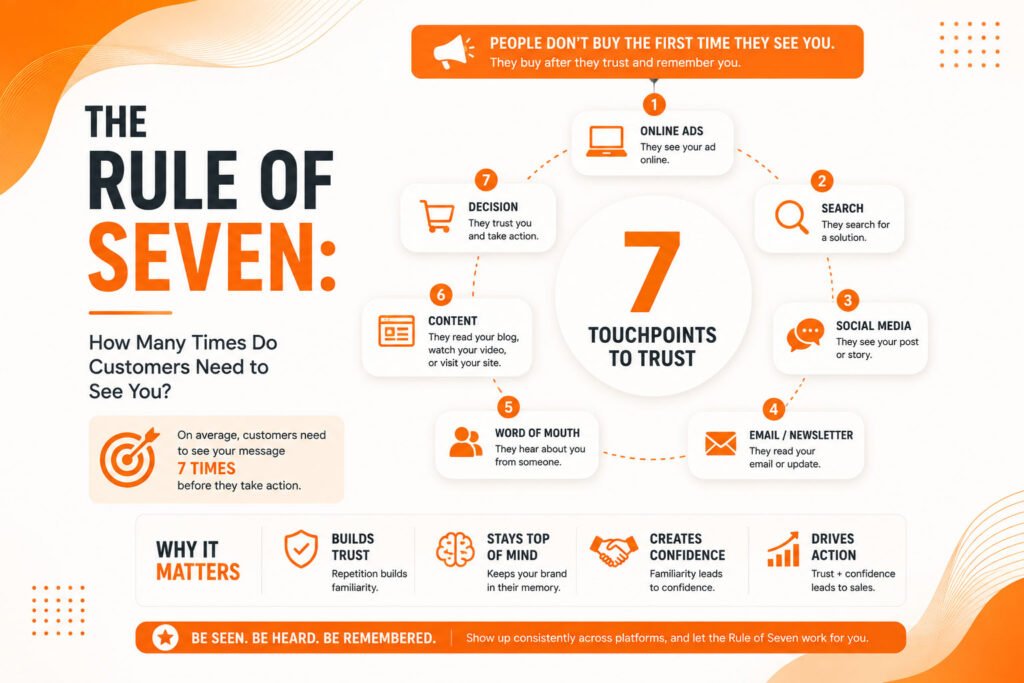
Rule of seven marketing originated decades ago in advertising theory, suggesting that a prospective customer generally needs to encounter a brand’s message roughly seven times before they’re genuinely ready to take action whether that’s making a purchase, requesting a quote, or booking a consultation call.
Marketing rule of 7 reflects a genuine psychological reality: trust builds gradually through repeated exposure, not instantly through a single advertisement or marketing touchpoint. A prospect seeing your business for the very first time rarely converts immediately, regardless of how compelling that single message might genuinely be on its own.
The Building Blocks of Effective Frequency Strategy
How many touchpoints before purchase genuinely varies by industry and price point, but understanding the underlying principle helps shape a more realistic, patient marketing approach.
- Consistent brand presence across multiple channels
- Varied content formats reinforcing the same core message
- Retargeting strategy capturing repeat exposure efficiently
- Patience matching campaign expectations to realistic conversion timelines
- Value delivery at each touchpoint, not just repeated selling
When these elements work together, repeated exposure builds genuine trust and familiarity rather than feeling like repetitive, unwelcome advertising pressure.
Ready for a marketing strategy built around genuine, realistic frequency?
Why Repetition Genuinely Builds Trust
Brand exposure marketing works because familiarity itself functions as a genuine trust signal, even when a prospect can’t fully articulate why. Psychological research on the “mere exposure effect” demonstrates that people generally develop more positive feelings toward things they’ve simply encountered repeatedly, independent of the actual content or quality of what they’ve encountered.
This explains why a business appearing consistently across multiple channels search results, social media, retargeting ads, email genuinely feels more established and trustworthy than one appearing only once, even if the underlying product or service quality is functionally identical. Repeated, consistent presence itself communicates legitimacy and staying power.
💡
Tip
Map out every touchpoint a prospect might realistically encounter with your brand organic search, social ads, retargeting, email before assuming a single campaign should convert immediately. The cumulative frequency across channels matters more than any single touchpoint.
Has the Rule Genuinely Changed in the Digital Era
Repetition in advertising principles from the original rule of seven predate digital marketing entirely, originating in an era of primarily print and broadcast advertising with far fewer channels and touchpoints available. Some marketers argue the actual number matters less today than the underlying principle, since digital channels now offer considerably more frequent, varied opportunities for genuine touchpoint accumulation across a shorter overall timeframe.
Regardless of whether the exact number “seven” remains precisely accurate, the core underlying principle remains genuinely relevant: expecting immediate conversion from a single marketing touchpoint sets unrealistic expectations, while building a sustained, multi-channel presence over time genuinely produces stronger, more reliable conversion results.
7
Traditional estimate of touchpoints needed before purchase decision
80%
Of sales require at least 5 follow-up touchpoints after initial contact
44%
Of salespeople give up after just one follow-up attempt
Applying Frequency Strategy Across Multiple Channels
Marketing frequency shouldn’t mean repeatedly showing the exact same advertisement to the same audience seven times, which risks genuine ad fatigue and diminishing returns rather than building trust. Instead, effective frequency strategy varies content format and channel a prospect might encounter a blog post through search, then a related social media post, then a retargeting ad, then an email each reinforcing the same core message through genuinely different, complementary formats.
This channel and format variety keeps content feeling fresh and valuable rather than repetitively identical, while still accumulating the cumulative brand exposure and trust-building repetition the underlying rule of seven principle describes, without triggering the negative fatigue response purely repetitive, identical advertising frequently produces.
Balancing Patience With Genuine Value at Every Touchpoint
How many touchpoints before purchase genuinely occur shouldn’t excuse purely repetitive, low-value marketing messaging repeated without genuine variation or improvement. Each touchpoint should ideally deliver some form of genuine value useful information, social proof, a relevant offer rather than simply repeating an identical sales pitch that provides no additional reason for the prospect to reconsider their previous, unconverted response.
This value-first approach transforms repeated exposure from potentially irritating repetition into a genuinely helpful, ongoing relationship-building process, where each touchpoint incrementally builds trust and understanding rather than simply repeating the same request for conversion without offering anything additional in return.
Customers rarely say yes the first time they see you they say yes once they've seen enough of you to genuinely trust what you're saying.
Common Marketing Frequency Mistakes to Avoid
Even experienced marketers fall into familiar traps: expecting immediate conversion from a single campaign or touchpoint, repeating identical messaging without genuine variation across channels, or abandoning a marketing effort too early before sufficient cumulative touchpoints have genuinely occurred.
The fix isn’t obsessing over reaching exactly seven touchpoints it’s building patient, multi-channel, value-driven marketing that accumulates genuine trust over realistic timeframes rather than expecting instant results.
How IWS Solutions Can Help
Our team builds multi-channel marketing strategies designed around genuine, realistic frequency and touchpoint accumulation, helping prospects build the trust they need before converting, rather than expecting immediate results from a single campaign.