
ECOMMERCE
BUSINESS MODEL
Dropshipping vs Traditional eCommerce: Pros and Cons
Two fundamentally different ways to sell online, each with real tradeoffs here’s how to decide which model actually fits your goals.
Why This Decision Shapes Everything That Follows
Dropshipping vs traditional ecommerce represents one of the most consequential early decisions for anyone starting an online store, since it affects everything downstream startup capital required, profit margins, quality control, and how much operational complexity you’ll be managing day to day.
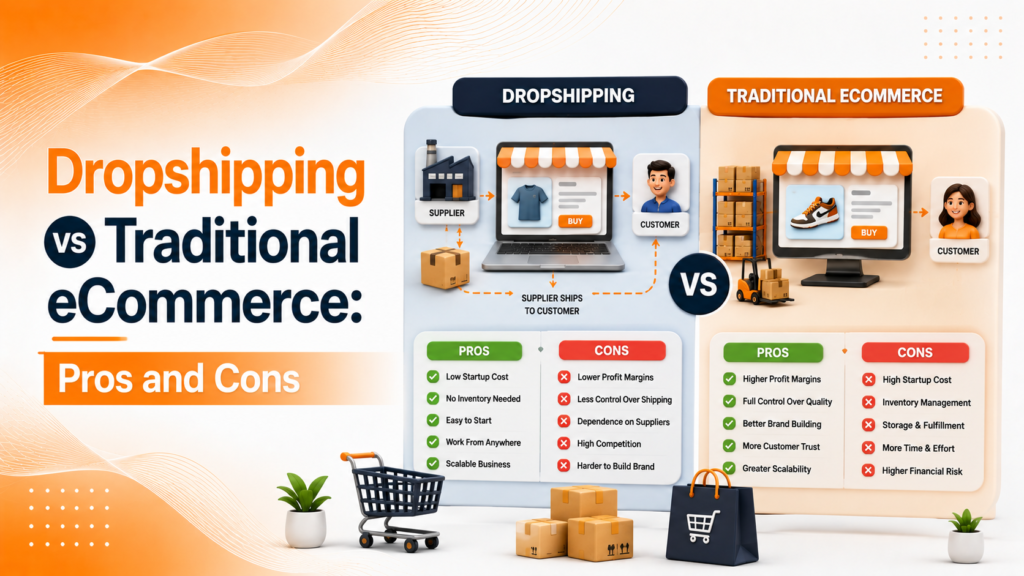
Dropshipping business model stores never physically hold inventory; instead, orders get forwarded to a third-party supplier who ships directly to the customer. Traditional ecommerce model businesses purchase and hold their own inventory, handling storage, packing, and shipping directly or through a dedicated fulfillment partner.
The Building Blocks of Each Model
Dropshipping pros and cons need to be weighed against traditional inventory-based selling across several genuinely important factors.
- Startup capital required varies dramatically between models
- Profit margins typically favor traditional inventory ownership
- Dropshipping offers lower risk but less quality control
- Traditional ecommerce requires more upfront investment and storage
- Shipping speed and customer experience differ significantly
Understanding these tradeoffs helps determine which model genuinely aligns with your available resources and business goals.
Ready to build an online store on the right business model?
The Case for Dropshipping
Is dropshipping worth it? For entrepreneurs with limited startup capital, dropshipping offers a genuinely accessible entry point into eCommerce no upfront inventory purchase, no warehouse or storage costs, and significantly lower financial risk if a particular product doesn’t sell as well as anticipated.
This lower barrier to entry also allows for rapid product testing across a wide catalog without the financial commitment traditional inventory would require. A dropshipping business model can list dozens of products simultaneously, quickly identifying winners without having pre-purchased stock for items that ultimately don’t resonate with customers.
💡
Tip
If considering dropshipping, order samples of your top products yourself before listing them. Experiencing your supplier's actual shipping time and product quality firsthand reveals issues customer complaints would otherwise surface later.
The Tradeoffs Dropshipping Involves
Dropshipping vs inventory comparisons consistently reveal dropshipping’s significant downsides alongside its accessibility. Profit margins tend to run considerably thinner, since suppliers set wholesale pricing that leaves less room for markup compared to businesses purchasing inventory in bulk at genuinely wholesale rates.
Quality control also becomes a real challenge, since the business never physically handles products before they reach customers defects, packaging issues, or supplier errors become visible only through customer complaints after the fact, rather than being caught proactively during an internal quality check process.
10–30%
Typical dropshipping profit margins vs 20–50% for traditional inventory
2–15 Days
Common dropshipping shipping times vs 1–3 days for traditional fulfillment
27%
Of online retailers use dropshipping as at least part of their business model
The Case for Traditional eCommerce
Traditional ecommerce model businesses generally achieve stronger profit margins, since purchasing inventory in bulk typically secures better wholesale pricing than the per-item markup dropshipping suppliers charge. This margin advantage compounds significantly as sales volume grows, often making inventory ownership considerably more profitable at scale despite higher upfront costs.
Holding your own inventory also provides genuine quality control and faster shipping times, since products can be inspected before storage and typically ship within a day or two from your own fulfillment process, rather than depending on a third-party supplier’s separate, often slower shipping timeline.
The Tradeoffs Traditional eCommerce Involves
The clear downside is upfront financial risk. Traditional ecommerce requires purchasing inventory before knowing definitively how well it will sell, creating genuine risk of unsold stock tying up capital, particularly for new product lines without established sales history to inform purchasing decisions confidently.
Storage and fulfillment logistics also require either dedicated warehouse space or a third-party fulfillment partnership, both of which introduce additional operational complexity and cost that a dropshipping model simply doesn’t require the business to manage directly.
Which Model Genuinely Fits Your Situation
Neither model is universally superior the right choice depends on available startup capital, risk tolerance, and long-term business goals. Dropshipping suits entrepreneurs wanting to test product-market fit with minimal financial risk, while traditional ecommerce suits businesses with capital to invest and a clearer, more validated sense of what will genuinely sell.
Some businesses even use a hybrid approach, starting with dropshipping to validate demand before transitioning proven, reliably selling products into traditional inventory ownership once sales data justifies the increased upfront investment and operational commitment.
Dropshipping trades margin and control for accessibility. Traditional ecommerce trades accessibility for margin and control. Neither is wrong they just serve different starting points.
Common Business Model Mistakes to Avoid
Even motivated entrepreneurs fall into familiar traps: choosing dropshipping without vetting supplier reliability and shipping times, or committing to traditional inventory before genuinely validating product demand first.
The fix isn’t assuming one model is universally better it’s honestly matching the model to your available capital, risk tolerance, and validated product demand before committing significant resources either way.
How IWS Solutions Can Help
Our team helps entrepreneurs build eCommerce stores suited to their specific business model, whether dropshipping, traditional inventory, or a hybrid approach, ensuring the technical foundation supports how you actually plan to operate.