
A/B TESTING
CONVERSION OPTIMIZATION
A/B Testing Your Website A Beginner's Guide
Stop guessing what works a practical introduction to testing real changes against real data to improve conversions with confidence.
Why Guessing Isn't a Strategy
Most businesses make website changes based on opinion a redesigned button “feels” better, a new headline “sounds” more compelling. Website A/B testing replaces that guesswork with actual data, showing definitively which version of a page element genuinely performs better with real visitors, rather than relying on assumptions about what should work.
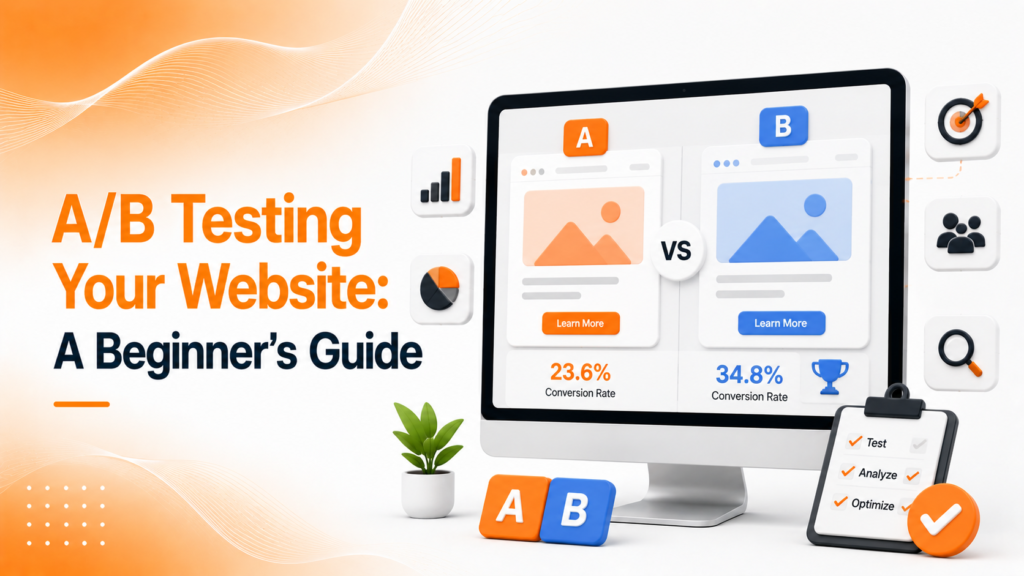
A/B testing for beginners can feel intimidating, but the core concept is straightforward: show half your visitors one version of a page element, show the other half a different version, then measure which one actually drives more conversions. The version with better real-world performance wins, regardless of which one anyone personally preferred beforehand.
The Building Blocks of a Proper A/B Test
Split testing isn’t randomly changing things and hoping for improvement it’s a structured process that together produces genuinely reliable, actionable results.
- A clear, single hypothesis being tested
- Sufficient traffic to reach statistical significance
- Only one variable changed per test
- A defined success metric decided before testing begins
- Enough test duration to account for normal traffic variation
When these elements are in place, test results genuinely reflect real visitor preference rather than random chance or incomplete data.
Ready to test your way to better conversions?
Starting With a Clear Hypothesis
Every effective A/B test begins with a specific hypothesis, not a vague hope for improvement. Rather than “let’s test a new headline,” a proper hypothesis states something like “changing the headline to focus on speed instead of price will increase sign-ups because our audience research shows speed matters more to them.”
This specificity matters because it clarifies exactly what you’re testing and why, making results genuinely interpretable afterward. A vague test without a clear hypothesis often produces a “winning” result without any real understanding of why it won, limiting what you can actually learn and apply to future decisions.
💡
Tip
Before running your first test, write down what you expect to happen and why. If the actual result differs from your prediction, that gap often teaches more about your audience than a confirmed hypothesis would.
Testing One Variable at a Time
How to run an A/B test correctly means changing only a single element between your two versions just the headline, or just the button color, but not both simultaneously. Testing multiple changes at once makes it impossible to know which specific change actually drove any observed difference in performance.
This discipline can feel slow compared to redesigning an entire page at once, but it’s exactly what makes A/B testing genuinely informative rather than just another unexplained redesign. Each isolated test builds a clearer, more reliable picture of what specifically influences your particular audience’s behavior.
12%
Average conversion rate improvement from ongoing A/B testing programs
1,000+
Minimum recommended visitors per variant for reliable results
2–4 Weeks
Typical minimum test duration to reach statistical significance
Understanding Statistical Significance
Conversion rate optimization through testing only works reliably when a test runs long enough and with enough traffic to reach statistical significance the point where results are unlikely to have happened purely by random chance. Ending a test too early, based on early results that look promising, frequently leads to false conclusions that don’t hold up with additional data.
Most A/B testing tools automatically calculate significance levels, removing the need for manual statistical calculation, but understanding the underlying concept helps avoid the common mistake of declaring a “winner” prematurely, before the data has genuinely stabilized into a reliable, trustworthy pattern.
Choosing What to Test First
For businesses new to testing, A/B testing tools work best applied first to high-traffic, high-impact pages a homepage headline, a primary call-to-action button, or a checkout page element where even modest improvements translate into meaningful, measurable business impact given the volume of visitors already passing through.
Starting with smaller, less-trafficked pages often means tests take considerably longer to reach statistical significance simply due to lower visitor volume, making early testing efforts feel unproductive even when the underlying methodology is genuinely sound.
A/B testing doesn't tell you what you want to hear it tells you what your actual visitors genuinely respond to, which is far more valuable.
Common A/B Testing Mistakes to Avoid
Even data-conscious businesses fall into familiar traps: ending tests too early based on promising initial results, testing multiple variables simultaneously, or running tests on pages with too little traffic to ever reach meaningful statistical significance.
The fix isn’t testing everything at once it’s testing methodically. A disciplined, single-variable testing process consistently produces more reliable, actionable insights than rushed, poorly structured tests.
How IWS Solutions Can Help
Our team helps businesses implement structured A/B testing programs, from hypothesis development to results analysis, turning website optimization into a genuinely data-driven, ongoing process.