
WEB SECURITY
SSL CERTIFICATES
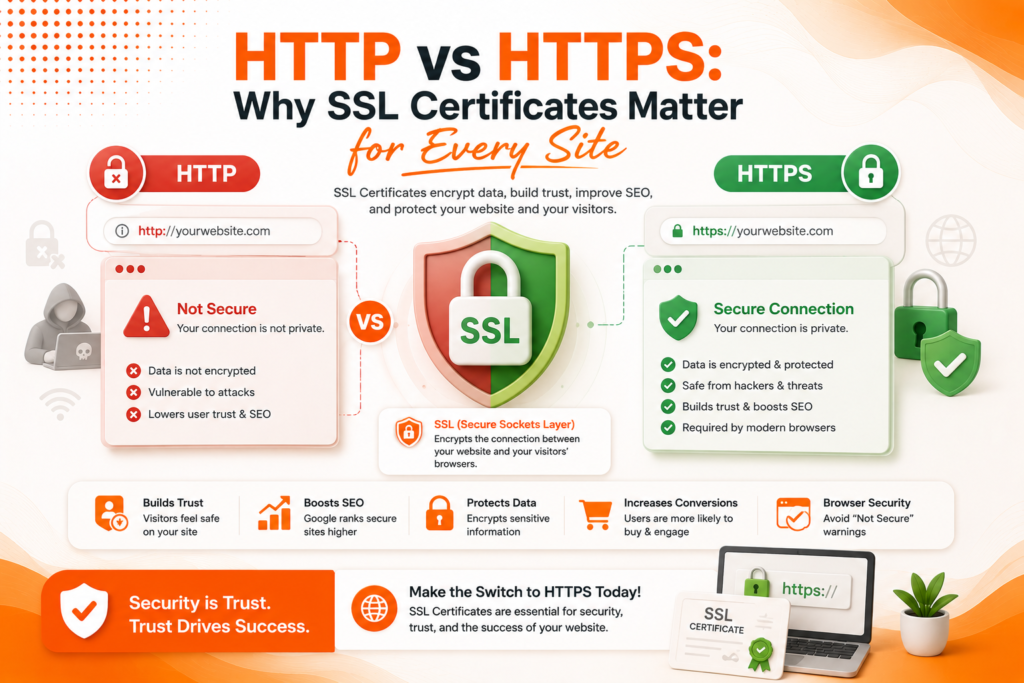
HTTP vs HTTPS Why SSL Certificates Matter for Every Site
A small padlock icon that carries real weight for security, trust, and search rankings alike.
Why This Distinction Matters More Than It Looks
HTTP vs HTTPS represents the difference between an unencrypted and encrypted connection between a visitor’s browser and your website’s server. HTTPS website connections scramble data in transit, meaning sensitive information passwords, payment details, personal data can’t be easily intercepted by anyone monitoring network traffic between the visitor and your site.
Why SSL matters extends well beyond just protecting sensitive form submissions, though. Browsers now actively flag HTTP-only sites as “not secure,” directly in the address bar, creating an immediate trust concern for visitors regardless of whether that specific page actually collects any sensitive information at all.
The Building Blocks of Proper SSL Implementation
An SSL certificate isn’t just installed once and forgotten it’s a combination of proper setup and maintenance that together ensure genuine, ongoing security.
- A valid, correctly installed SSL certificate
- Automatic HTTPS redirect from any HTTP requests
- Regular certificate renewal before expiration
- Mixed content resolved so all resources load securely
- Proper configuration avoiding browser security warnings
When these elements are maintained together, a site provides genuinely secure, trustworthy connections for every visitor.
Ready for a website that's genuinely secure and trusted?
How SSL Certificates Actually Protect Data
An SSL certificate establishes an encrypted connection between a visitor’s browser and your web server, ensuring any data transmitted form submissions, login credentials, payment information remains scrambled and unreadable to anyone potentially intercepting that network traffic. Without this encryption, data travels in plain, readable text, genuinely vulnerable to interception.
This protection matters for any site collecting user data through forms, not just eCommerce stores processing payments directly. Even a simple contact form or newsletter signup transmits personal information that deserves the basic protection encryption provides, regardless of how sensitive that specific data might initially seem.
💡
Tip
Check your site right now for mixed content warnings images or scripts still loading over HTTP even after HTTPS is enabled. These create browser warnings even on an otherwise properly secured site.
The SEO Benefits of HTTPS
SSL SEO benefits are genuine and well-documented Google explicitly confirmed HTTPS as a ranking signal, meaning secure sites receive a modest but real advantage over otherwise comparable HTTP sites competing for the same search rankings. While this signal alone won’t overcome significantly weaker content or technical SEO elsewhere, it’s a straightforward, achievable advantage worth capturing.
Beyond direct ranking impact, HTTPS also affects user behavior indirectly. Visitors seeing a “not secure” warning frequently leave immediately rather than risk proceeding, and this elevated bounce rate itself can negatively affect rankings, compounding HTTP’s disadvantage beyond the direct ranking signal alone.
85%
Of internet users avoid sites marked "not secure" by their browser
95%+
Of top-ranking Google search results now use HTTPS
Free
Cost of basic SSL certificates through most modern hosting providers
Understanding Different SSL Certificate Types
SSL certificate types vary in validation depth and coverage scope. Domain Validation (DV) certificates confirm basic domain ownership and represent the most common, straightforward option for most websites. Organization Validation (OV) certificates involve additional verification of the actual business behind the domain, providing slightly stronger trust signals.
Extended Validation (EV) certificates require the most thorough verification process, historically displaying the company name directly in the browser address bar, though browser display conventions have shifted somewhat in recent years. Wildcard certificates, meanwhile, cover an entire domain including all subdomains under one single certificate, simplifying management for sites with multiple subdomains.
Ensuring Complete Migration From HTTP to HTTPS
imply installing an SSL certificate isn’t sufficient on its own proper migration requires setting up automatic redirects from any HTTP requests to their HTTPS equivalent, ensuring visitors and search engines consistently land on the secure version regardless of which URL they originally requested or had previously bookmarked.
Mixed content issues also need resolving, where a page loads over HTTPS but still references some resources images, scripts, stylesheets via insecure HTTP links. These create browser warnings even on a properly SSL-secured site, undermining the trust signal the certificate was meant to establish in the first place.
That small padlock icon isn't just a technical detail it's often the difference between a visitor trusting your site enough to stay, or leaving the moment they see 'not secure.'
Common HTTPS Migration Mistakes to Avoid
Even technically capable teams fall into familiar traps: installing an SSL certificate without setting up proper redirects, leaving mixed content unresolved, or letting certificates expire unnoticed until visitors start encountering security warnings.
The fix isn’t just installing a certificate once it’s maintaining complete, ongoing HTTPS implementation. A properly migrated, consistently secure site avoids both the trust and ranking penalties HTTP-only sites increasingly face.
How IWS Solutions Can Help
Our team ensures every website we build or manage has properly configured SSL, complete HTTPS migration, and ongoing certificate maintenance, protecting both your visitors’ data and your search rankings.