
DIGITAL MARKETING
COPYWRITING
How to Write Ad Copy That Actually Converts
The proven principles behind ad copy that stops the scroll, builds desire, and drives real clicks not just impressions.
Why Most Ad Copy Fails to Convert
Most underperforming ads aren’t losing because of bad targeting or insufficient budget they’re losing because the ad copy itself fails to connect. How to write ad copy that converts starts with recognizing that people don’t care about your product; they care about what changes for them once they have it.
Converting ad copy leads with the customer’s problem or desire, not a list of company features. An ad describing “our software has advanced reporting features” performs far weaker than one saying “stop wasting hours building reports manually” same underlying product, completely different persuasive framing.
The Building Blocks of High-Converting Ad Copy
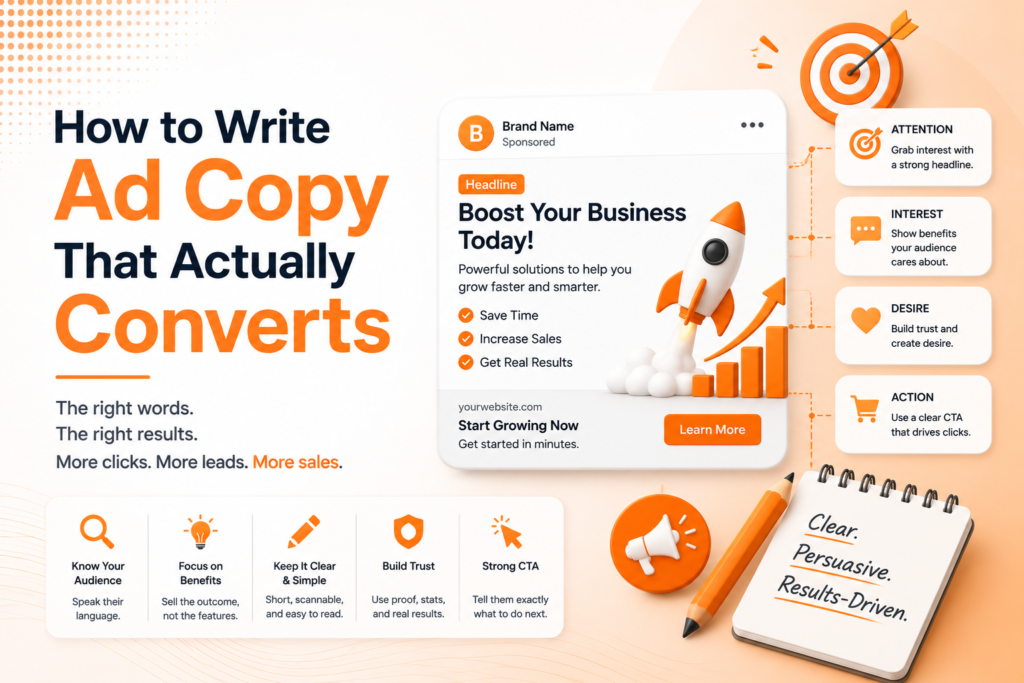
Ad copywriting isn’t one clever headline it’s a combination of structural elements that together move a reader from scrolling past to clicking through.
- A hook that immediately grabs attention within the first line
- Clear focus on customer benefit, not just product features
- Specific, credible claims rather than vague promises
- A single, clear call-to-action
- Urgency or relevance that makes acting now feel natural
When these elements work together, ad copy stops competing purely on creativity and starts genuinely persuading.
Ready for ad copy that actually drives clicks and conversions?
Start With the Hook
The first line of any ad determines whether the rest gets read at all. PPC ad copy competing in search results needs to immediately signal relevance to the exact query someone just typed, while Facebook ad copy needs to interrupt a scroll with something genuinely attention-grabbing within the first few words.
Questions, bold statements, or directly naming the reader’s specific problem all tend to outperform generic openers. “Tired of slow website load times?” immediately signals relevance to anyone actually experiencing that problem, far more effectively than a vague opening about “improving your business.”
💡
Tip
Read your ad copy out loud. If it sounds like something you'd actually say to a friend explaining the offer, it's probably working. If it sounds like corporate marketing language, rewrite it.
Focus on Benefits, Not Just Features
Copywriting for ads consistently underperforms when it lists product specifications instead of translating them into genuine customer benefits. A feature like “24/7 customer support” means little on its own — but reframed as “never wait until Monday to get help” makes the same fact immediately meaningful to someone evaluating the offer.
This shift requires genuinely understanding what customers actually care about, not just what the business considers impressive about its own product. The best ad copy examples almost always center the customer’s outcome, not the company’s capabilities.
80%
Of ad performance is influenced by headline effectiveness alone
47%
Higher click-through rate for benefit-focused vs feature-focused copy
3x
More conversions from ads with a single, clear call-to-action
Be Specific, Not Vague
Vague claims like “the best solution for your business” persuade almost nobody, since every competitor makes the same unsubstantiated claim. Specific numbers, timeframes, or results “cut your reporting time by 40% in the first month” carry far more credibility and genuinely differentiate an offer from generic competing claims.
This specificity applies to calls-to-action too. “Learn More” tells a reader almost nothing about what happens next, while “Get Your Free Website Audit” clearly sets expectations and reduces the hesitation that comes from an ambiguous next step.
Match Copy to the Platform
Facebook ad copy and PPC ad copy require genuinely different approaches, since they’re reaching people in different mindsets. Search ads reach people actively looking for a solution right now, so copy can be direct and solution-focused immediately. Social ads interrupt browsing, so copy often needs a stronger hook to first earn attention before introducing the offer itself.
Platform-native tone matters here too copy that feels like a native, conversational post tends to outperform obviously corporate, ad-like language, particularly on social platforms where users are primarily browsing for content, not shopping.
Test, Don't Guess
Even experienced copywriters can’t reliably predict which specific headline or angle will perform best for a given audience without real data. A/B testing multiple ad copy variations different hooks, different benefit framing, different calls-to-action reveals what genuinely resonates, rather than relying on assumption alone.
This testing process should be ongoing, not a one-time exercise. Audience preferences shift, competitors change their messaging, and what worked six months ago may quietly stop performing as well without regular refreshing and retesting.
People don't click on ads because they're clever they click because the ad made them feel understood in the first three seconds.
Common Ad Copy Mistakes to Avoid
Even experienced marketers fall into familiar traps: leading with company features instead of customer benefits, using vague calls-to-action, or writing one version of copy and never testing alternatives against it.
The fix isn’t more creativity it’s more customer focus. Copy that clearly speaks to a specific reader’s problem will consistently outperform clever, feature-focused writing almost every time.
How IWS Solutions Can Help
Our team writes and tests converting ad copy across platforms, from PPC search ads to social media campaigns, focused on genuine customer benefit rather than generic, forgettable messaging.