
SEO
WEBSITE AUDIT
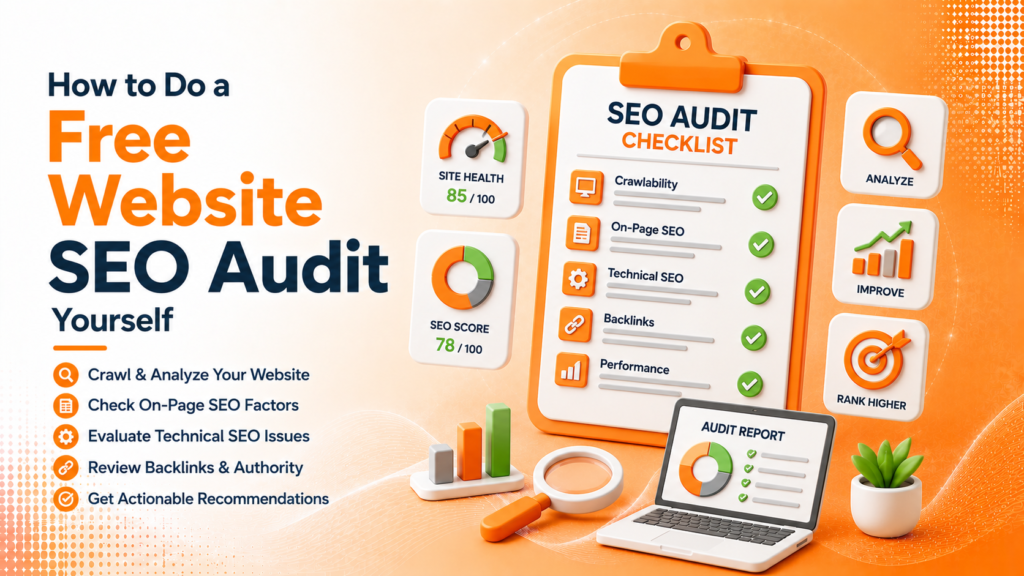
How to Do a Free Website SEO Audit Yourself
A practical, step-by-step checklist to check your website’s SEO health — no expensive tools or agency required to get started.
Why Every Website Needs a Regular SEO Audit
Most websites accumulate SEO problems quietly over time — a broken link here, a slow-loading image there, a page that no longer matches what it once ranked for. None of these issues announce themselves. They just gradually chip away at rankings until traffic has dropped enough for someone to finally notice.
A proper seo audit checklist catches these issues before they compound. Whether you’re running it yourself with free tools or working with professional seo audit services, the goal is the same: identify exactly what’s holding your site back, in order of priority, rather than guessing at random fixes.
The Building Blocks of a Complete SEO Audit
A thorough audit isn’t one check — it’s a combination of technical, content, and competitive factors that together reveal the full picture of a site’s SEO health.
- Site speed and mobile responsiveness
- Crawlability and indexing status
- On-page elements like titles, headers, and meta descriptions
- Content quality and keyword alignment
- Backlink profile and competitor positioning
Reviewing these areas in sequence turns a vague “why isn’t my site ranking” question into a specific, prioritized action list.
Ready to see exactly what's holding your site back?
Step 1: Check Your Site's Technical Health
A technical seo audit service typically starts here, because technical issues can block search engines from properly crawling and indexing a site no amount of great content matters if Google can’t access it in the first place. Free tools like Google Search Console and PageSpeed Insights reveal crawl errors, mobile usability issues, and slow-loading pages in just a few minutes.
Pay close attention to Core Web Vitals scores and any pages marked as “not indexed” in Search Console. These are often the highest-impact fixes, since resolving them can unlock ranking potential for pages that were previously invisible to search engines entirely.
💡
Tip
Start your audit with Google Search Console's Coverage report. Pages showing errors there are actively being excluded from search results — fixing these first often delivers the fastest visible impact.
Step 2: Review On-Page SEO Elements
Next, work through your key pages checking title tags, meta descriptions, header structure, and keyword usage. Each page should have a unique, descriptive title and a clear H1 that matches what searchers are actually looking for duplicate or missing titles are a surprisingly common issue even on otherwise well-built sites.
For businesses with a local presence, a local seo audit adds an extra layer here checking whether location-specific keywords appear naturally in page content, and whether your Google Business Profile information matches what’s listed across your website consistently.
53%
Of mobile visitors leave a page that takes over 3 seconds to load
68%
Of online experiences begin with a search engine
94%
Of first impressions relate to website design and usability
Step 3: Audit Your Content and Competitors
Content review means looking honestly at whether existing pages still serve searcher intent outdated statistics, thin content, or pages that no longer match what people are actually searching for all quietly hurt rankings over time. Website seo audit services often flag these issues because they’re easy to overlook when you’re too close to your own content.
This is also where seo competitor analysis becomes valuable. Looking at what’s currently ranking above you for target keywords reveals real gaps content depth, missing topics, or better structured pages that a purely internal audit would miss entirely.
For online stores specifically, an ecommerce seo audit should additionally review product page optimization, duplicate content across similar product variants, and whether category pages are properly structured to capture broader, higher-volume search terms.
Step 4: Check Your Backlink Profile
Finally, review your backlink profile using a free tool like Google Search Console’s Links report or a limited free scan from Ahrefs or Moz. Look for a healthy growth pattern over time, and watch for any suspicious, low-quality links that could be actively hurting your site’s trust with search engines.
For local businesses, this pairs well with a free local seo audit of your citation consistency checking that your business name, address, and phone number match exactly across every directory and listing where your business appears online.
You can't fix what you haven't measured — an SEO audit turns invisible problems into a clear, actionable list.
Common SEO Audit Mistakes to Avoid
Even motivated site owners fall into familiar traps: fixing minor issues while ignoring major technical errors, auditing once and never revisiting it, or focusing entirely on content while overlooking technical and backlink health.
The fix isn’t doing everything at once — it’s prioritizing correctly. Fixing the highest-impact technical issues first will move the needle far more than perfecting minor on-page details before the foundation is solid.
How IWS Solutions Can Help
Our team provides comprehensive seo audit services, covering technical, on-page, content, and competitor analysis giving you a clear, prioritized roadmap instead of a vague list of things that might be wrong.