
COMPARISON
WEB DEVELOPMENT
Static vs Dynamic Websites What's the Difference?
Why This Decision Matters Early On
One of the first decisions in any website project is choosing between a static and dynamic build and it’s a decision that shapes everything downstream, from development cost to how easily the site can grow later. Many business owners don’t realize this choice exists until they’re already deep into a project, which often leads to rebuilding sooner than expected.
Understanding what is the difference between static website and dynamic websites upfront helps you choose the right foundation the first time, rather than outgrowing a static site within a year or overpaying for dynamic functionality you never actually needed.
The Building Blocks of Each Website Type
Static and dynamic websites aren’t just different in appearance they’re built on fundamentally different technical foundations, which affects what each one can and can’t do well.
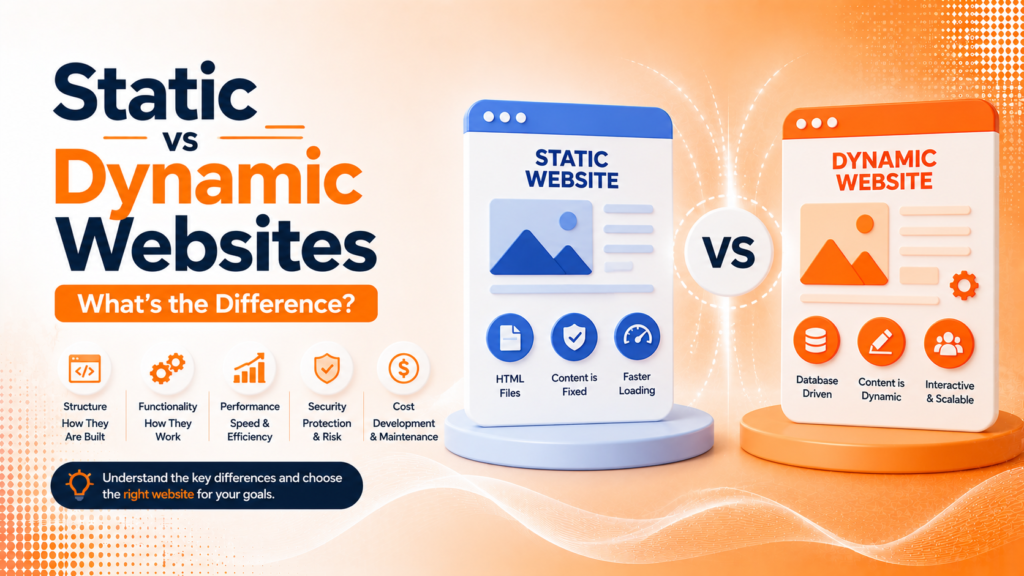
- Static sites serve the same fixed HTML content to every visitor
- Dynamic sites generate content in real time based on user or database input
- Static sites typically load faster with lower hosting costs
- Dynamic sites support features like logins, search, and personalization
- Static sites require developer help for most content changes; dynamic sites often don’t
Understanding these differences is the real starting point for deciding which type of website development services your project actually needs.
Ready to build the right type of website for your business?
What Is a Static Website?
It’s a site built with fixed HTML, CSS, and sometimes JavaScript files that display the exact same content to every visitor, every time, unless a developer manually edits the code. There’s no database pulling information in real time what you see is what was built and uploaded.
This simplicity is actually a major advantage in the right situation. Static sites load extremely fast, cost less to host, and have a smaller attack surface for security vulnerabilities, since there’s no database or server-side processing to exploit. For portfolio sites, landing pages, or small businesses with content that rarely changes, a static build is often the smarter, more cost-effective choice.
💡
Tip
If your content changes weekly or you need user accounts, don't force it onto a static site. The wrong foundation costs more to fix later than it does to build correctly now.
What Makes a Dynamic Website Different
A dynamic website pulls content from a database and generates pages on the fly, based on user input, login status, or other real-time factors. This is what powers features like personalized dashboards, search functionality, user accounts, and eCommerce stores none of which a static site can realistically support without significant workarounds.
The tradeoff is complexity. Dynamic sites generally cost more to build and host, since they require server-side processing and database management. But for businesses that need content to change frequently, support multiple users, or scale with growing functionality, that added complexity is what makes real growth possible in the first place.
Most custom website development projects for growing businesses end up being dynamic, simply because the functionality needed blogs, product catalogs, user accounts requires it.
2x
Faster average load time for static vs dynamic sites
73%
Of eCommerce and content-heavy sites require dynamic functionality
40%
Lower average hosting cost for static websites
SEO Considerations: Static vs Dynamic
SEO for static website builds tends to be more straightforward, since fast load speeds and simple structure are already strong ranking factors Google rewards. There’s less that can technically go wrong, since there’s no database or server-side logic to introduce errors.
That said, dynamic websites aren’t inherently worse for SEO they simply require more careful setup, since URLs, metadata, and content are often generated programmatically rather than written by hand. When configured correctly, dynamic sites can absolutely rank as well as static ones, while also supporting more sophisticated content strategies like blogs and category pages that static sites struggle to scale.
The question isn't which website type is better it's which one your business actually needs today, and whether it can grow with you tomorrow.
Common Mistakes to Avoid When Choosing
money, then needing frequent updates a developer has to make manually or choosing a fully dynamic, custom-built site for a simple five-page business that never needed that complexity in the first place.
The fix isn’t defaulting to one option it’s honestly assessing how the site needs to function today, and realistically, in the next year or two, before committing to a build.
How IWS Solutions Can Help
Our team offers both static and custom website development, and we start every project by understanding what your business actually needs not defaulting to whichever build type is easier to sell. The right foundation now saves you a costly rebuild later.