
SEO
CRAWL BUDGET
Crawl Budget: What It Is and Why Large Sites Should Care
Search engines don’t have unlimited time to crawl every page here’s why that matters more as your website grows.
Why Crawl Budget Becomes a Genuine Concern at Scale
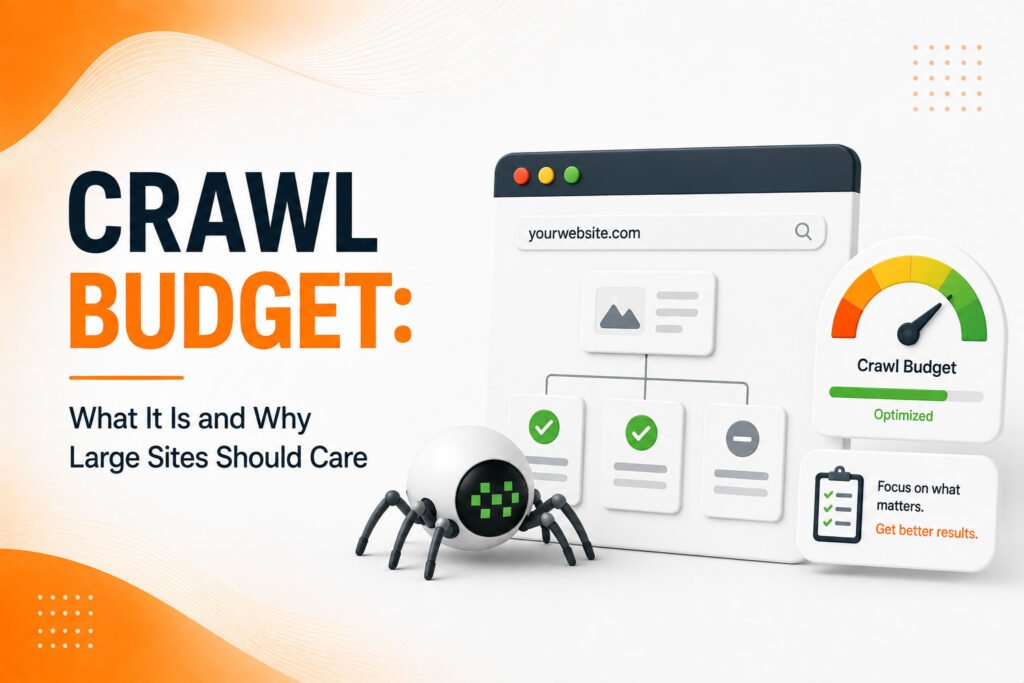
What is crawl budget? It’s the number of pages Google’s crawler is willing and able to crawl on your site within a given timeframe, determined by a combination of your site’s overall authority, server capacity, and how efficiently your site’s structure allows crawling to actually happen. For smaller sites, this rarely poses any genuine limitation.
Crawl budget SEO becomes a genuine, practical concern specifically for larger sites typically those with tens of thousands of pages or more where Google’s crawler simply can’t feasibly crawl every single page as frequently as a smaller site’s pages get crawled, making efficient crawl budget usage genuinely important for ensuring your most valuable pages get discovered and indexed promptly.
The Building Blocks of Crawl Budget Optimization
Improve crawl efficiency requires understanding and addressing several interconnected technical factors that together influence how search engines allocate crawling resources.
- Clean, efficient site architecture reducing unnecessary crawl paths
- Fast server response times supporting more efficient crawling
- Minimized duplicate content wasting crawl resources
- Strategic use of robots.txt directing crawler priorities
- Regular removal of low-value, thin, or outdated pages
When these factors are addressed together, search engines can crawl and index your genuinely valuable pages more efficiently, rather than wasting limited crawl resources on low-priority or duplicate content.
Ready for a site structure that uses crawl budget efficiently?
What Determines Your Site's Crawl Budget
Google crawl budget gets influenced by two primary factors: crawl rate limit (how many simultaneous connections Google’s crawler will make without overwhelming your server) and crawl demand (how much Google genuinely wants to crawl your site, based on factors like overall site popularity and how frequently content actually changes across your pages).
Sites with faster, more reliable server response times generally receive a higher crawl rate limit, since Google’s crawler can make more requests without risking server strain or slowdown. Sites with higher overall authority and more frequently updated, genuinely valuable content typically receive higher crawl demand, since Google recognizes ongoing value worth crawling more frequently and thoroughly.
💡
Tip
Check your Google Search Console crawl stats report to see exactly how many pages Google crawls daily on your site. A declining trend, without a corresponding site content reduction, often signals a crawl budget or technical issue worth investigating.
Why Duplicate Content Wastes Genuine Crawl Resources
Large site SEO challenges frequently trace back to duplicate content consuming crawl budget that could otherwise be spent discovering and indexing genuinely unique, valuable pages. E-commerce sites with numerous URL parameter variations for filtering and sorting are particularly prone to this issue, since each parameter combination can technically create a separate, crawlable URL despite showing essentially identical product content.
Addressing this waste through proper canonical tags, consolidated URL structures, or strategic robots.txt directives helps ensure Google’s limited crawl budget genuinely focuses on your unique, valuable pages rather than repeatedly crawling countless near-identical variations that provide no genuine additional indexing value.
10,000+
Approximate page threshold where crawl budget genuinely becomes a concern
40%
Average crawl budget wasted on duplicate or low-value pages for large sites
2-3x
Faster indexing of new content after crawl budget optimization
Using Robots.txt Strategically
Robots.txt files provide a genuine tool for directing crawler behavior, explicitly telling search engines which sections or URL patterns shouldn’t be crawled at all internal search result pages, admin areas, or duplicate parameter-based URLs that don’t need genuine crawling and indexing. This strategic exclusion helps preserve crawl budget for pages that genuinely matter.
This requires careful, deliberate implementation, though, since incorrectly blocking genuinely important pages can inadvertently prevent them from being indexed entirely, causing far more significant harm than the crawl budget inefficiency the robots.txt directive was originally meant to address in the first place.
Removing Low-Value Pages to Improve Overall Efficiency
Content pruning identifying and removing or consolidating genuinely thin, outdated, or low-value pages represents another effective crawl budget optimization approach for large sites. Every low-value page that remains crawlable continues consuming crawl resources that could otherwise be redirected toward your genuinely valuable, actively performing content.
This pruning process requires genuine analysis to distinguish between pages that are simply older but still valuable, versus pages that genuinely no longer serve any purpose and are actively wasting crawl resources without providing corresponding value to either search engines or actual site visitors browsing that content.
For most small sites, crawl budget is a non-issue. For large sites with hundreds of thousands of pages, it's the difference between new content getting discovered in days versus months.
Common Crawl Budget Mistakes to Avoid
Even technically sophisticated large sites fall into familiar traps: allowing extensive duplicate content from URL parameters to accumulate unaddressed, neglecting server response time optimization, or failing to monitor crawl stats data that would reveal genuine crawl budget inefficiencies before they meaningfully impact indexing.
The fix isn’t obsessing over crawl budget for smaller sites where it genuinely isn’t a limiting factor it’s addressing it deliberately once your site’s scale genuinely warrants the attention.
How IWS Solutions Can Help
Our team optimizes crawl budget efficiency for large websites, from technical architecture improvements to strategic content pruning, ensuring search engines can efficiently discover and index your most valuable pages.